

A founder shows a dashboard with charts, a chat panel and several empty navigation items. It communicates a product idea, but a prospective customer still cannot complete the job they came to do. More screens have not made the release more useful.
SaaS MVP development needs a narrower definition of progress: a specific customer can start, perform the important task and understand the result. The product also needs the basic controls required to operate that journey responsibly.
It does not promise that one feature, price or development timeline will validate a business.
Choose a customer job with a clear outcome
Name the intended customer and the recurring problem. Avoid a description so broad that every business could be the audience. A project coordinator managing client deliverables has different needs from a merchant answering order questions.
Write what the customer will have accomplished at the end of the journey. For example, a coordinator may need to collect a brief, review an asset and deliver the approved version. That outcome can guide decisions about screens, data and notifications.
Define how you will learn whether the result is useful. Interviews, observed task completion and an agreed pilot can provide different kinds of evidence. A positive reaction to a mockup alone does not establish willingness to adopt or pay.
Separate a prototype question from a release requirement
A prototype can test whether users understand an interaction or whether an integration is feasible. A product release must actually support the promised workflow and its operating requirements.
The UK Government's alpha-phase guidance describes prototypes used to test risky assumptions. It is public-service guidance, not a US startup launch standard. The useful distinction is that testing an idea and operating a service are different stages.
Keep a written list of what is simulated in the prototype. Before a release, replace those simulations with working behavior or clearly exclude them from the offering. Do not let a convincing demo become an accidental promise.
Scope the whole first journey
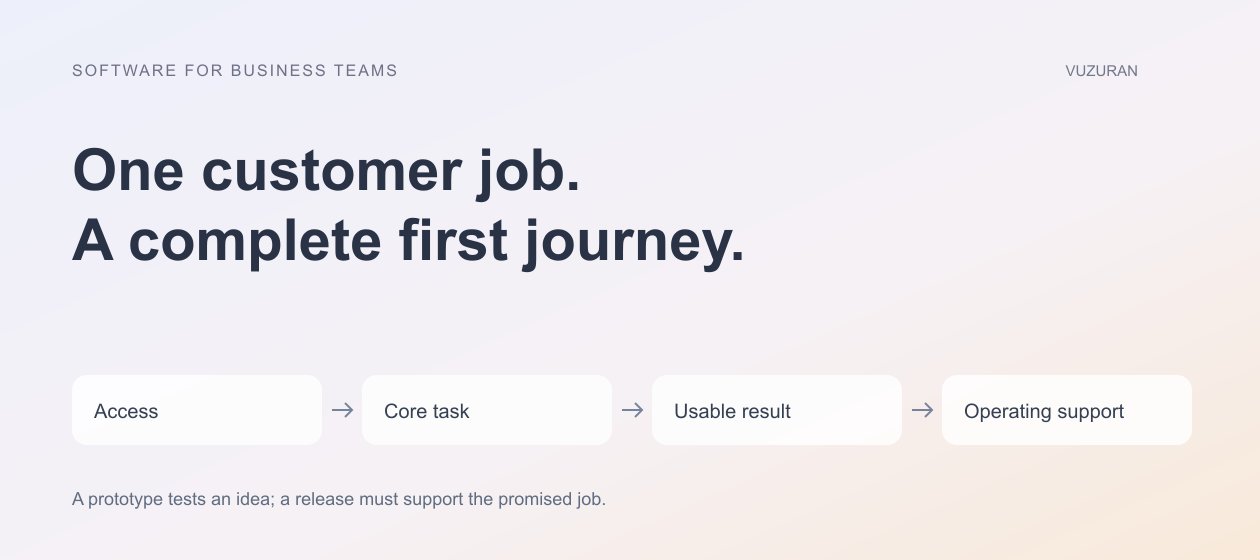
A useful narrow release still needs a beginning and an end. Include how the customer gains access, supplies the required input, performs the task and receives the result. Show what happens if information is missing or an operation fails.
| Journey stage | Minimum question | Evidence before release |
|---|---|---|
| Access | Can the intended customer enter safely? | Authentication and account-access checks |
| Setup | Can they provide the required information? | Observed onboarding with representative input |
| Core task | Does the product perform the promised job? | End-to-end acceptance case |
| Result | Can they understand and use the output? | Usable delivery or confirmed destination state |
| Exception | What happens when the task cannot finish? | Clear error, recovery or support path |
| Exit | Can they leave or manage their account as agreed? | Working account and data-handling process |
This table does not require every possible feature. It prevents a release from stopping halfway through the customer job.
Keep customer boundaries in the architecture
If several customers use the application, access to one account must not expose another. Define how records, files and permissions belong to the correct customer or organization.
OWASP's authorization guidance recommends least privilege and permission validation on requests. Apply those checks to the actual records and actions, including direct links and APIs. A customer sidebar that hides another account is only a visual layer.
Account isolation is part of the first working product, not a cosmetic improvement to add after adoption.
Test with separate accounts and representative files. Verify that guessed identifiers, changed URLs and shared links do not bypass the intended access rules.
Use AI as a scoped capability
If the product includes an assistant, define what it can read and do. Keep unsupported requests, uncertain results and human review visible. Do not label the entire product “autonomous” because a model can generate the next step.
A first release might prepare a draft while the customer confirms it. That can provide real utility and useful evaluation evidence. A later release can expand the action boundary after the team has tested the consequences.
Our custom assistant brief explains how to define sources, permissions and acceptance cases before choosing a model.

Instrument the customer outcome
Track the stages that reveal whether a user can finish the job. A page view or sign-in count does not show that the customer successfully delivered an asset or resolved an inquiry.
Define events such as setup completed, task started, result confirmed and exception raised. Use only the data needed for the approved measurement purpose. Keep the difference between activity, completion and business value clear in reports.
During the pilot, watch people use the product and ask where they hesitate. A repeated support question can reveal a missing explanation or broken interaction that a high-level chart conceals.
Plan operation before opening access
Identify the product owner, deployment process, monitoring and support route. Test backups and recovery appropriate to the system. Confirm how credentials and provider accounts are managed and what happens when an external service is unavailable.
If billing is in scope, verify the actual purchase and entitlement flow in the appropriate test environment. Do not mark an account paid from a client-side success screen alone. Keep pricing, access and cancellation behavior consistent with the offering.
Keep a release checklist that distinguishes implemented, tested and pending work. A feature shown in navigation should either work as described or be clearly unavailable; an empty destination creates confusion rather than useful anticipation.
Use the pilot to decide the next release
Review completion evidence, support issues and user feedback against the original job. Decide what to improve, remove or expand. Do not automatically turn every request into the next feature.
VUZURAN builds custom B2B tools, AI applications and SaaS. A discovery conversation can start with the customer job, riskiest assumption and first complete journey. The aim is a release you can evaluate and operate, with a scope that supports the next business decision.
Frequently asked questions
Is an MVP just a smaller feature list?
It needs a focused but usable customer journey. A short list of disconnected screens can still fail to deliver the intended job.
Can a prototype be launched unchanged?
Only after the actual release requirements are implemented and verified. Simulated data or interactions must not be mistaken for working production behavior.
Should account isolation wait until there are more customers?
No. If the product serves separate customers, their access boundaries belong in the initial architecture and testing.
What should determine the next feature?
Use evidence from the core journey, support needs and the business goal. Prioritize changes that improve a real outcome rather than expanding navigation for its own sake.
Sources & context
- GOV.UK: How alpha works
Primary reference reviewed October 27, 2026. Public-service methodology is identified as such; business frameworks and examples are original VUZURAN editorial guidance.
- OWASP: Authorization Cheat Sheet
Primary reference reviewed October 27, 2026. Public-service methodology is identified as such; business frameworks and examples are original VUZURAN editorial guidance.
Written by VUZURAN. Examples labeled hypothetical are illustrative; they are not customer results. VUZURAN service references describe our own business.