

A request for a custom AI assistant often begins with a familiar interface: a chat window that can answer questions and take actions. The interface says little about the difficult parts. Which information can it read? Who may ask it to change a record? How does the business know an action really happened?
Those questions belong in the brief before the team chooses a model or designs the conversation. They shape the data connections, application controls and review experience around the assistant.
VUZURAN develops custom AI tools and business software. This guide explains the information we would want to assess a project; it is not a promise that every capability is available in a fixed package or timeline.
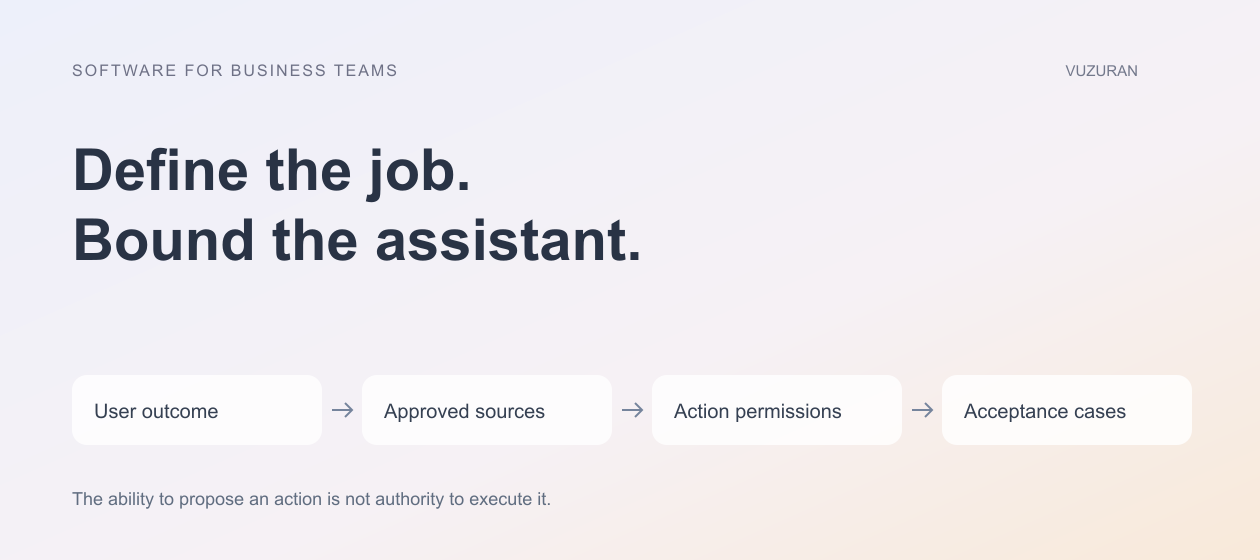
Describe the user and the finished job
Name the person using the assistant and the task they need to complete. An internal project coordinator finding a delivery requirement has a different job from a customer asking about an order.
Write a concrete finish line. “Answer questions about projects” is broad. “Show the authorized user the current milestone and the source of its status” gives the team something to implement and test.
Include where the assistant appears and what happens after its response. A standalone chat, an embedded panel and a proposed action inside a dashboard can require different interface decisions. Choose the surface around the work rather than copying a chat layout because it is familiar.
Inventory the sources with their owners
List the systems and documents the assistant needs. For each, identify who owns it, who can access it and how the current version is established. Record any missing or contradictory information.
A collection of files is not automatically a usable knowledge base. The assistant needs a way to distinguish an approved procedure from an old draft and a customer-specific record from general guidance.
Our internal knowledge assistant guide provides a source-register example. For the project brief, the key deliverable is a map of authorized information, not a promise to connect everything immediately.
Define permissions at the action level
Separate reading, preparing, proposing and executing. An assistant may be allowed to draft a response without sending it, or propose a task without changing its owner. State those boundaries explicitly.
OWASP's authorization guidance recommends least privilege and checking permissions on requests. In a custom assistant, the application must enforce access to the specific record and action. A hidden button or a sentence in the system prompt is not a complete authorization mechanism.
The assistant's ability to suggest an action should not silently become permission to perform it.
Include administrative roles, client roles and any shared records in the brief. Test with accounts that have different access, including attempts to reach a record through an identifier rather than the normal interface.
Specify the evidence for an answer
Decide when the assistant should cite a document, show a record link or display a last-updated time. A reader should be able to check a material claim without starting another search.
For a missing answer, define the expected behavior. The assistant might ask a clarifying question, show the gap or route the request to a person. Filling the space with a plausible answer should not be treated as success.
| Requirement | Example brief detail | Acceptance evidence |
|---|---|---|
| Source-backed answer | Use the current approved procedure | Citation supports the specific statement |
| Record access | Client sees only assigned projects | Cross-account checks remain denied |
| Proposed action | Draft a milestone update | Reviewer sees the exact change |
| Confirmed action | Save an approved update | Destination record reflects the change |
| Unsupported request | Route to the named team | Context reaches the responsible person |
These examples are illustrative. The project's actual acceptance cases should reflect the business and its consequences.
Design the review experience
If a person must approve something, give them the context needed to decide. Show the proposed change, target record, supporting information and uncertainty. A generic approval button without the underlying details can turn review into a ritual.
Bind approval to the reviewed version. If the assistant regenerates a message or changes a destination, apply the re-approval rule. Decide what happens when the reviewer is absent or does not respond.
Include a way to reject, correct or return the item for more information. Rejection is useful feedback when it preserves the reason and helps the team improve the workflow.
Put failures into the scope
Connections expire, source systems slow down and external writes can produce uncertain results. Ask the team to show how the assistant exposes those states and what the operator can do next.
A model response saying “done” should not be the only completion evidence. Verify the actual destination record or provider confirmation. Our API integration guide explains the difference between a rejected request and a lost response after a successful write.
Define which actions can be retried and how duplicate operations are prevented. Keep a manual fallback for important work while the pilot is being evaluated.
Agree on evaluation and handover
Prepare representative tasks, boundary cases and expected outcomes before launch. Include a separate final set so the assistant is not accepted only on examples used during development. Record the configuration and sources used for the test.
The handover should identify the application's owner, deployment process, credential responsibilities, monitoring and support arrangement. Confirm how the business requests a change and what work falls outside the initial engagement.
A useful first release may be smaller than the original idea. That can be a good decision when it completes one important job and supplies evidence for the next stage. It should not be confused with a demo that merely resembles a finished application.
To discuss a custom assistant with VUZURAN, bring a representative request, the required sources and the action boundary to a discovery conversation. The first assessment can determine whether a native tool, a connected workflow or custom software fits the requirement.
Frequently asked questions
Do we need to choose the model before the brief?
Start with the user job, data and acceptance requirements. Model selection should follow the task and approved operating constraints.
Can we connect every company document at once?
Begin with an owned, authorized source collection. Verify access and freshness before expanding to more material.
Should all assistant actions be automatic?
No. Reading, drafting and executing can have different permissions and review requirements. Define each action deliberately.
What proves the assistant is ready?
Use agreed acceptance cases, integration evidence and operating checks. A polished conversation alone does not establish production readiness.
Sources & context
- OWASP: Authorization Cheat Sheet
Primary reference reviewed October 27, 2026. Public-service methodology is identified as such; business frameworks and examples are original VUZURAN editorial guidance.
Written by VUZURAN. Examples labeled hypothetical are illustrative; they are not customer results. VUZURAN service references describe our own business.