

A startup can run surprisingly far on a spreadsheet, a form and a few shared inboxes. The arrangement becomes harder to defend when a customer request has no clear owner, staff copy the same details between tools and nobody can explain which record is current.
Custom B2B software may help at that point. It also creates a product the business must maintain. Before commissioning a build, identify the gap that existing tools cannot reasonably close and the operating outcome that would justify the effort.
This is VUZURAN's own guide to assessing that decision. We build custom business tools, AI agents and SaaS; we also recognize that an existing product or a simpler process can be the better starting point.
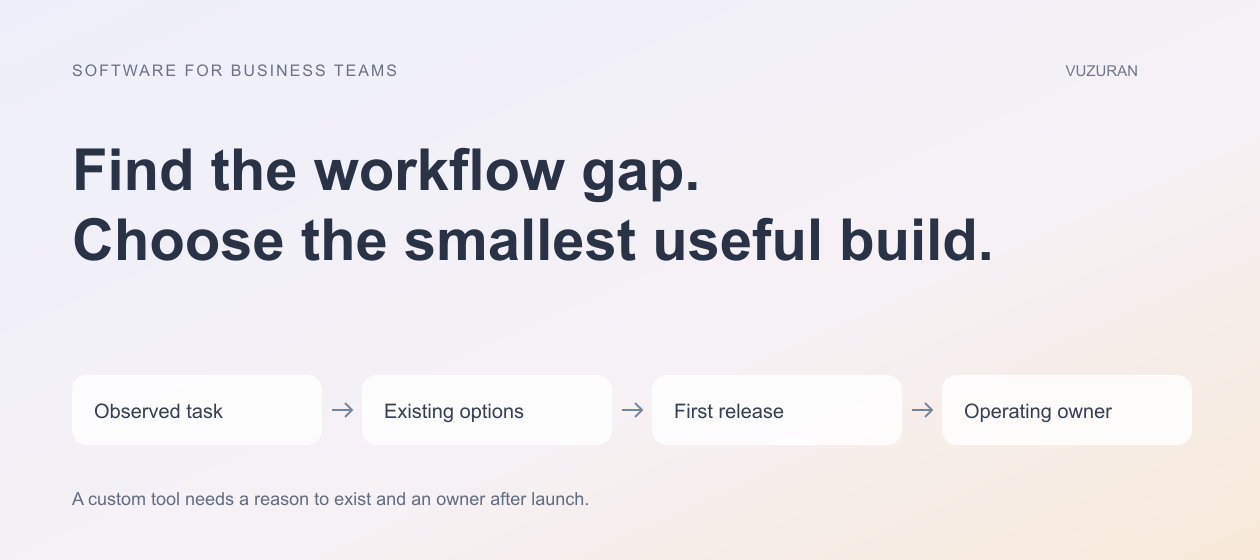
Observe the workaround in use
Ask a teammate to complete an ordinary task while explaining where information comes from and what happens next. Record the handoffs, repeated entry and moments when they leave one application to check another. Avoid designing screens before understanding why those steps exist.
Look for recurring friction rather than an isolated annoyance. A missing label is different from an entire approval process managed through private messages. Estimate how often the problem appears and what it costs in delay, correction or lost visibility.
The UK Government's discovery-phase guidance emphasizes understanding the problem before committing to a service. It is public-service methodology, not a requirement for US startups. The relevant lesson for this decision is to investigate the workflow before selecting a solution.
Identify the gap existing products leave
List the current tools and the capabilities available in the plans you actually use. Try a small configuration change or native integration where it could solve the problem. Include the effort of migration and staff training when comparing options.
Custom work becomes easier to justify when the missing behavior is specific: a permission model that spans client projects, a specialized approval chain or a record that must stay consistent across several systems. “We want our own dashboard” is a less useful reason unless the dashboard enables a defined job.
Build around a verified workflow gap, not the assumption that owning more software is progress.
Document why a candidate product does not fit. The explanation may reveal that the real issue is unclear ownership or inconsistent data, which new software would otherwise inherit.
Compare the operating choices
Use a decision table that includes responsibility after launch. A subscription and a custom build have different cost structures, but neither is free of operating work.
| Option | Useful when | Responsibility to include |
|---|---|---|
| Improve the current process | The rules are unclear or the volume is modest | Training, ownership and consistent use |
| Configure an existing product | Standard features cover the important job | Configuration, permissions and recurring fees |
| Connect existing tools | Each system works but handoffs are fragile | Integration monitoring and recovery |
| Build a focused internal tool | The workflow has a specific, important gap | Product ownership, maintenance and support |
| Build a customer-facing SaaS product | A repeatable customer job is supported by evidence | Access, isolation, onboarding and ongoing operation |
A hybrid can be appropriate. The business might retain its CRM while building a narrow review interface around a process the CRM does not handle well.
Define a first release with an end-to-end outcome
Choose one user and one job that the release will complete. Include the minimum screens, data and permissions needed to make that journey useful. A collection of attractive screens without a finished workflow is not a meaningful first release.
For illustration, an inquiry tool might receive a request, show the original context, assign an owner and record a confirmed next action. It does not need every future reporting feature to establish whether the core process helps.
Write acceptance cases before implementation. Include missing information, duplicate submissions and a failed connection. Our project-brief guide explains how to turn those cases into a scope both teams can review.
Put AI where interpretation is useful
A custom application does not need AI in every step. Rules can validate a required field or enforce access. A model might help summarize a long inquiry or suggest a category, with the original message visible for review.
Separate suggestions from confirmed facts and authorized actions. A model-generated summary should not silently change a contract, issue a refund or assign a commercial commitment. Define those boundaries in the application rather than relying only on a prompt.
Our agents-versus-workflows guide helps distinguish predictable steps from work that needs more flexible interpretation.

Include the cost after the launch
Estimate hosting, provider usage, maintenance, monitoring and the time an internal owner spends reviewing changes. Ask how credentials are managed and what happens if a key integration stops working.
Keep the source code, deployment instructions and relevant assets in an agreed handover. Define who can access them and how a new maintainer would run the application. A product that depends entirely on one person's memory is difficult to operate even if the first version works.
Do not compare a custom build's full operating cost with only the headline price of a subscription. Include the actual configuration and integration work on both sides.
Make the next decision smaller
If the gap is still uncertain, use a limited discovery or prototype to answer the riskiest question. That might be whether the required integration exists, whether users understand the proposed workflow or whether the data is usable.
A prototype should have a stated question and a way to evaluate the answer. Avoid treating visual approval as proof that the production system is ready. Access controls, recovery and operational ownership still need implementation and verification.
VUZURAN can help turn a workflow problem into a scoped software project. Bring an example input, the current tools and the outcome you need to a discovery conversation. We can assess whether configuration, integration or a custom first release fits the requirement.
Frequently asked questions
Is custom software always more expensive than SaaS?
The answer depends on scope, usage and operating responsibility. Compare total cost and fit over the relevant period rather than development price against subscription price alone.
Should a startup replace all its tools at once?
A focused release is usually easier to evaluate. Retain systems that work unless there is a clear reason to replace them, and test the handoffs between old and new.
Does custom B2B software need AI?
No. Use AI where interpretation helps the job. Deterministic rules and ordinary interfaces may be better for predictable steps.
What should we bring to an initial discussion?
Bring the current workflow, a representative example, the systems involved and a definition of a useful outcome. A clear problem is more valuable than an extensive screen wish list.
Sources & context
- GOV.UK: How discovery works
Primary reference reviewed October 27, 2026. Public-service methodology is identified as such; business frameworks and examples are original VUZURAN editorial guidance.
Written by VUZURAN. Examples labeled hypothetical are illustrative; they are not customer results. VUZURAN service references describe our own business.