

A founder asks for an agent that handles new customer inquiries. During discovery, the job turns out to have five familiar steps: validate the form, find the account, categorize the request, draft a response, and assign a reviewer. Only one step requires interpreting language. Does the whole process need to be an agent?
The answer affects how you test the system, explain its decisions, and recover when something fails. An agent and a predefined workflow can both use Claude. The important difference is who chooses what happens next.
Separate the model from the control structure
A model can classify text inside an otherwise ordinary application. It can also propose which tool to use and what information to request. Those are different uses of the same underlying capability.
Anthropic's Building effective agents distinguishes workflows with predefined paths from systems where the model directs its process and tool use. The article was originally published in December 2024 and now includes a notice that its tooling landscape has changed. Its architectural distinction remains useful; its old product examples should not be treated as a current feature list.
Using an AI model does not, by itself, require handing the model control of the entire process. Start by deciding where judgment belongs, then select the implementation.
Map the next-step decisions
Take a real task and write its decision points. “If the email is missing, stop and request it” is a rule. “Determine which of several services this unusual request needs” requires interpretation. “Investigate a problem across several systems until a supported explanation is available” may require a more flexible sequence.
The following comparison is an original planning worksheet, not a performance benchmark:
| Process characteristic | Predefined workflow fits when | Agent control may help when |
|---|---|---|
| Next step | A rule identifies it reliably | The next useful action depends on findings |
| Available tools | A small, stable sequence covers the job | Several tools may be needed in varying order |
| Finish line | A specific output completes the task | Completion requires evaluating gathered evidence |
| Recovery | A failed step has a known fallback | The system must choose an alternative investigation |
Do not score a process from its marketing name. A “research agent” may be a fixed search-and-summary workflow. A modestly named support tool may make several consequential decisions.
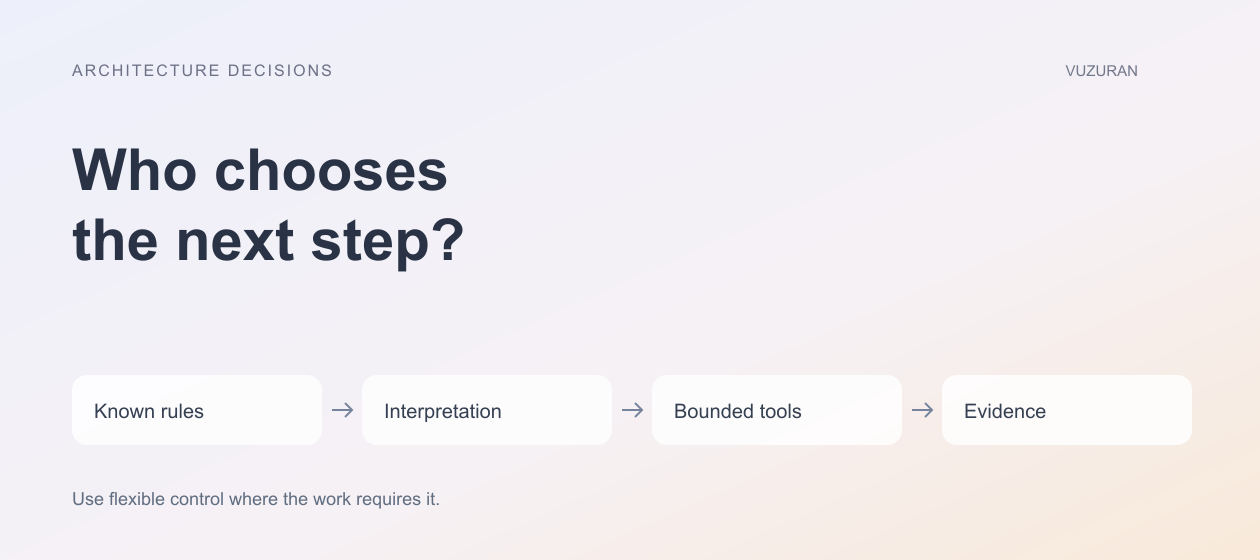
Keep predictable work predictable
Consider a hypothetical US consulting firm receiving project requests. Required fields can be validated with code. Existing accounts can be matched by a stable identifier. An AI model can suggest a category and write a draft reply, while the application routes the result to a named reviewer.
This design gives the team a specific place to investigate an error. If the category is wrong, review that step and its input. If the reviewer never receives the task, inspect routing and delivery. A single broad instruction to handle everything can make those responsibilities harder to separate.
A predefined workflow can still branch, retry, or pause. “Predefined” does not mean every input gets the same treatment. It means the allowable transitions are designed and testable before a particular run begins.
Give flexible work a budget
An agent can be useful when the sequence genuinely varies. Imagine a staff member investigating why a customer's reported usage differs from an invoice. The system may need to retrieve permitted records, compare dates, identify missing information, and decide whether another lookup is necessary.
Define limits before connecting it. Set the allowed tools, accessible records, maximum steps, and a clear condition for asking a person. A model should not continue exploring indefinitely because it has not found a satisfying explanation.
Anthropic's tool-use documentation describes the mechanics for giving Claude tools. Your application still needs to validate requested actions and enforce access. A tool definition is a capability description; it is not evidence that the proposed action should be authorized.
Test the decision, not the label
Build examples around the actual work. Include ordinary requests, incomplete data, contradictory records, and tasks outside scope. For a workflow, check each branch and its recovery path. For an agent, also check whether it chooses appropriate tools, stops at the right time, and explains unresolved uncertainty.
Record what “good” means before testing. A support summary might need the correct account, cited source records, and an explicit statement when information is missing. An answer that sounds confident but invents a record should fail even if its tone is excellent.
Compare review effort as well as completion rate. If a flexible agent produces a plausible answer that takes longer to verify than the original task, the design has more work to do. Avoid measuring only the speed at which text appears.
Design the human handoff
Some actions should stay with a person during a pilot: sending commitments, changing permissions, or approving financial adjustments. Define what the reviewer sees and whether a changed proposal needs renewed approval.
A useful operating principle is:
Give the system enough freedom to complete its assigned investigation, and give the team enough evidence to check what it found.
This is VUZURAN's editorial recommendation. It is not a quotation from Anthropic or a claim about a customer deployment.
When the system stops, preserve the useful work already done. A handoff should include the original request, sources consulted, proposed next step, and the specific uncertainty that prevented completion. “Something went wrong” leaves the employee to start over.
Choose a first release you can maintain
Write a brief with the process owner, allowed actions, source systems, evaluation examples, and recovery responsibilities. Then decide which parts need a model and which parts need straightforward software. The result may combine a fixed workflow with one flexible investigation step.
VUZURAN builds AI agents and connected business tools. In a workflow discovery conversation, the useful question is what the team needs to accomplish and verify. The answer may justify custom agent behavior, a narrow integration, or an existing tool. Choosing the simpler adequate design keeps future changes easier to understand.
Frequently asked questions
Is an agent always more capable than a workflow?
It has more freedom to choose a path, which can help with variable tasks. That freedom also creates more behavior to evaluate. It does not guarantee a better business outcome.
Can one application use both?
Yes. A predefined process can call a model for a specific judgment or delegate a bounded investigation, then resume a fixed approval and delivery sequence.
Does Claude automatically enforce our company permissions?
Your application must enforce access and validate actions. Model instructions should complement those controls, not replace them.
How should we decide which design to pilot?
Map recent real examples. If reliable rules determine the next step, start with them. Add flexible control where the examples show a genuine need, and keep an evaluation set for future changes.
Sources & context
- Anthropic: Building effective agents
Primary reference reviewed October 27, 2026. Article analysis and examples are original VUZURAN editorial guidance.
- Claude: Tool use documentation
Primary reference reviewed October 27, 2026. Article analysis and examples are original VUZURAN editorial guidance.
Written by VUZURAN. Examples labeled hypothetical are illustrative; they are not customer results. VUZURAN service references describe our own business.