

A subscription looks inexpensive beside a custom development estimate. A custom build looks attractive beside years of recurring fees. Either comparison can mislead when it leaves out the work required to configure, integrate, review and maintain the system.
The build-versus-buy decision is a choice about fit and operating responsibility. It should answer which option supports the business job, what remains with your team and what evidence justifies the commitment.
VUZURAN develops custom AI tools and B2B software. This is our own decision framework, not an independent ranking or an argument that every business should commission a build.
Define the job before comparing products
Write the task, intended user, required sources and finished outcome. Identify the permissions and exceptions that matter. A vague requirement such as “an AI operations platform” makes almost any demonstration look relevant.
Separate essential behavior from preferences. A preferred card layout may be negotiable; the ability to prevent one client from accessing another's files is not. Keep those distinctions visible when reviewing options.
Our project-brief guide provides a structure for defining the first workflow. Use the same brief for product trials and custom estimates so the comparison remains fair.
Include configuration and integration as options
The choice is rarely limited to a subscription used unchanged or a complete custom platform. Configuring an existing product, adding a connector or building a narrow interface around current systems may solve the gap.
| Option | What you gain | Responsibility to examine |
|---|---|---|
| Buy a standard product | Existing features and a managed product roadmap | Fit, configuration and vendor dependence |
| Configure native automation | Reuse current systems and accounts | Rules, permissions and ongoing administration |
| Integrate existing tools | Preserve useful products while fixing handoffs | Field ownership, recovery and monitoring |
| Build a focused custom tool | Behavior designed around the specific job | Product ownership, development and maintenance |
| Build a broader platform | Greater control over a larger workflow | Larger scope, migration and operating burden |
A hybrid can be sensible. The important question is which custom behavior is necessary and which standard capability can remain with a maintained product.
Test the gaps that matter
Give each candidate a representative task and a few difficult cases. Confirm the exact integration, access rules and output format. Do not accept a connector name or polished screenshot as proof that the required workflow works.
If an existing product lacks one feature, ask whether the missing behavior is truly essential. A modest process adjustment may be cheaper to operate than a permanent custom extension. Conversely, a workaround that repeatedly loses context can justify more focused development.
The right option is the one whose verified fit and ongoing responsibility the business can accept.
Record unresolved assumptions. A product trial that cannot test a required capability should remain inconclusive on that point rather than receive an optimistic score.
Compare total operating cost
Include subscription or development fees, hosting, provider usage, setup, training, review effort and maintenance. State the period and assumptions. Keep one-time migration work separate from recurring costs.
A custom system needs someone to own updates, credentials and incidents. A purchased product may still require configuration, source cleanup and integration support. Neither option removes the business's responsibility for using the tool appropriately.
NIST's Secure Software Development Framework, reviewed October 27, 2026, provides a reference for discussing secure development and maintenance responsibilities with providers. It is not a price model or certification for any option in this article.
Use measured pilot effort where possible. Our ROI guide explains why time saved, available capacity and cash savings should not be treated as identical benefits.
Inspect data and access boundaries
Ask where information goes, which accounts the software uses and who can see generated outputs. Review the applicable product and configuration rather than infer controls from a vendor's general reputation.
For a custom build, define those boundaries in the architecture and acceptance tests. For a product, verify whether the intended plan supports the required access and data-handling behavior.
Our data privacy guide provides an inventory for this assessment. A cheaper option is not eligible if it cannot satisfy a non-negotiable requirement for the actual use case.
Plan the exit before the commitment
Inspect export formats, source ownership and the process for moving to another solution. A downloadable file may not include every relationship, workflow rule or permission needed to reconstruct the system elsewhere.
Test a small export and explain what a future migration would require. For custom work, agree on repositories, build instructions, provider accounts and deployment access. Control over source code is useful only when someone can understand and operate it.
Do not assume a custom build has no lock-in. It can depend on specialized knowledge, proprietary services or undocumented behavior. The handover should make those dependencies visible.
Use a focused pilot to reduce uncertainty
Choose the question most likely to change the decision: integration feasibility, user adoption, review effort or source quality. Give the pilot an outcome and stop condition.
Keep the original requirement and evaluation record. If the team changes the scope during the pilot, note the change rather than comparing results from different jobs as though they were equivalent.
A pilot may show that the best choice is to wait, improve the process or use a simpler tool. That is useful evidence. The purpose is to support a decision, not to make every experiment lead to a larger implementation.
Make ownership part of the final decision
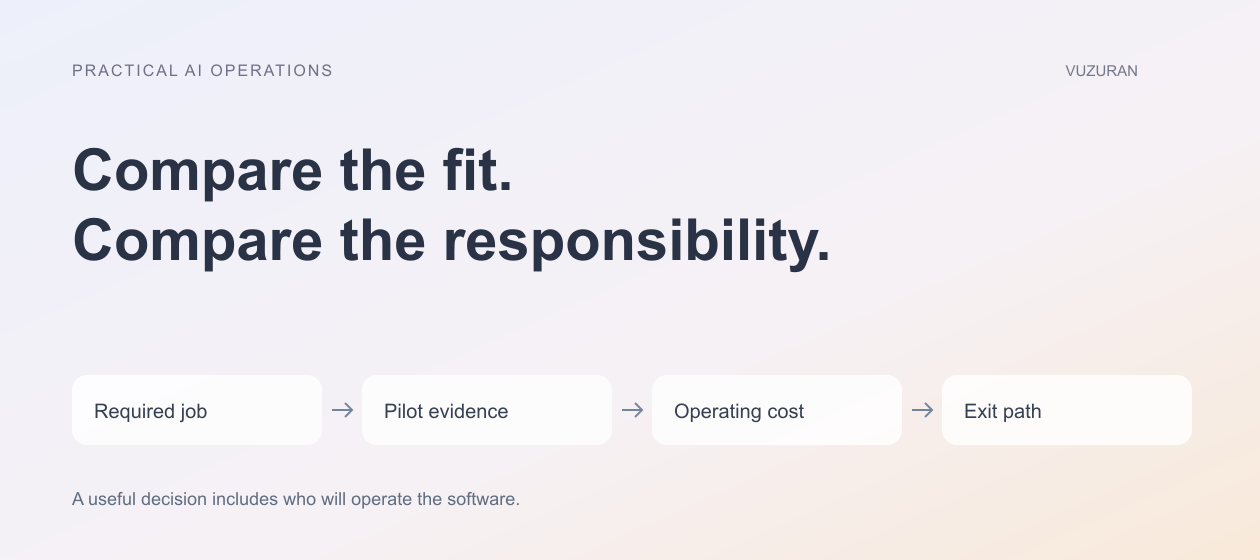
Name the person who will operate the chosen solution and review changes. Confirm support, incident response and the work your team still performs. A technically strong option can be a poor organizational fit if nobody can maintain it.
VUZURAN can assess existing tools, integrations and custom software through a discovery conversation. Bring the business job, must-have boundaries and trial evidence. A useful recommendation should explain both what to build or buy and why that operating arrangement fits the team.
Frequently asked questions
Is buying always faster?
A standard product can shorten implementation when it fits. Configuration, migration, permissions and integrations can still require meaningful work.
Does custom software eliminate vendor dependence?
No. It can depend on cloud services, libraries, APIs and specialist knowledge. Document those dependencies and the handover.
What should a pilot prove?
Choose a specific uncertainty that affects the decision and define the evidence needed. A successful demonstration of an unrelated feature is not enough.
Can the correct decision be to wait?
Yes. If the process is unclear, the gap is minor or the operating responsibility is not justified, improving the current approach may be more sensible.
Sources & context
- NIST: Secure Software Development Framework
Primary reference reviewed October 27, 2026. Original editorial framework and hypothetical business examples; no certification, legal-compliance or outcome guarantee.
Written by VUZURAN. Examples labeled hypothetical are illustrative; they are not customer results. VUZURAN service references describe our own business.