

A team approves an assistant to summarize customer requests. The visible task is small, but the information may pass through a website, application server, model provider, logging service and review inbox. Disconnecting the original mailbox later does not necessarily remove the copies already created along that path.
AI agent data privacy starts with understanding that path. The business needs to know what information is used, why it is needed, who can access it and what remains after the task finishes.
This article offers an original technical planning framework for US businesses. It is not legal advice or a determination that a particular implementation satisfies privacy obligations. Involve the appropriate privacy, security and legal owners for the actual data and use case.
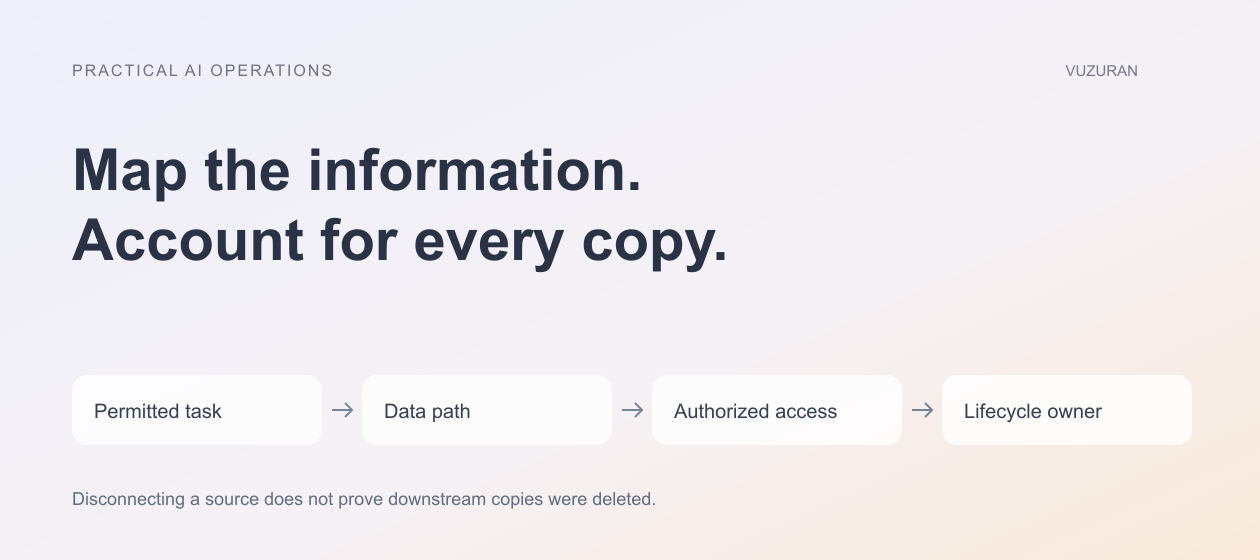
Describe the permitted task
Write the specific job the agent will perform and the information needed to complete it. A summary of a new inquiry may not require a full customer history, every attachment or unrelated internal notes.
Separate necessary context from information included merely because the connector can retrieve it. Reduce the working set before trying to solve every concern through model instructions.
The NIST Privacy Framework, reviewed October 27, 2026, is a voluntary resource for identifying and managing privacy risk. The inventory below is VUZURAN editorial guidance, not a certification or a substitute for a project-specific assessment.
Draw the complete data path
List each stage from collection to deletion or approved retention. Include temporary storage, diagnostic logs, backups and generated outputs. A diagram of the main application alone may miss the services used for notifications or debugging.
For each stage, identify the provider, purpose, access and retention decision. Confirm the applicable product settings and agreements rather than relying on a general statement about a vendor's brand.
| Data stage | Question to answer | Evidence to keep |
|---|---|---|
| Collection | Which fields and files enter the workflow? | Input schema and purpose |
| Retrieval | Which records may this user access? | Identity and authorization rule |
| Processing | Which provider receives the content? | Approved product and configuration |
| Review | Who sees the proposed output? | Role and record-level access |
| Logging | What diagnostic data is retained? | Redaction and retention settings |
| Output | Where does the result become another copy? | Destination and lifecycle owner |
Keep the map current when the workflow gains another tool or communication channel. A small feature change can introduce a new destination for the same information.
Check the identity behind the connection
A connector may run with an individual user's account, a service identity or another shared credential. Establish which identity is used for each action and what it can access.
Do not assume the assistant automatically inherits the permissions you intended. Test the same question with two accounts that have different record access. Include direct identifiers and file links in the test, not only the normal navigation.
A useful answer should be limited by the user's authorized information, even when broader data is available to the application.
Our internal knowledge assistant guide discusses source ownership and permission-aware retrieval. The data-flow review should include both what is retrieved and what is later displayed.
Review generated copies
A summary, draft email or exported report can contain personal or confidential information from the source. Treat it as a new artifact with its own access and retention requirements.
Ask what happens when the source record is corrected, access is revoked or the connection is removed. The application may need a process for finding and handling downstream copies. Do not promise that disconnecting a source automatically erases every result created from it.
Keep the distinction between source deletion, application deletion and backup handling visible in the operating documentation. The correct process depends on the system and approved policy.
Make logging deliberate
Logs help diagnose failures, but full prompts and responses can reproduce sensitive material unnecessarily. Decide which metadata is sufficient: an operation identifier, error category, configuration version or redacted field may answer the question without retaining the entire conversation.
Restrict access to detailed diagnostic views and define how long they remain. Check failed requests as well as successful ones; an error payload can contain the same private information as the original input.
Our monitoring guide separates business state from technical traces. That separation can make the operator's view useful without exposing every intermediate detail to every user.
Prepare a permitted test dataset
Use synthetic or appropriately authorized examples when developing and evaluating the workflow. Avoid copying a production customer export into a new tool simply because it is convenient for testing.
Include cases where the request asks for information outside the user's access. Verify the application response and any downstream action. A polite refusal in the final text does not establish that no sensitive data was retrieved or transmitted earlier.
Record what the test can prove. A small set can reveal a failure, but passing it does not establish that every possible disclosure path has been eliminated.
Give lifecycle decisions an owner
Someone must review provider changes, update the data map and respond to access or deletion requests through the approved process. Identify that owner before launch and include the relevant teams in changes that affect data handling.
Document how credentials are revoked and how an incident is escalated. A workflow should be pausable without losing incoming work or obscuring which actions already happened.
For a pilot, review one complete job from input to retained output. Follow its identifiers through the systems and compare the actual path with the diagram. Investigate any unexplained copy or destination.
VUZURAN builds custom AI tools and connected business software. A discovery discussion can begin with the permitted task and data-flow inventory. A narrower source connection or existing approved product may be sufficient when it meets the operating requirement.
Frequently asked questions
Does using an enterprise plan settle every privacy question?
No. The actual product, settings, data flow, access and retention still need review. Do not assume one plan label answers the entire assessment.
Should every prompt be saved for debugging?
Only retain what is appropriate for the diagnostic purpose and approved policy. Consider metadata and redaction instead of full-content logging by default.
Does disconnecting a source delete generated summaries?
Not necessarily. Review the downstream artifacts and each system's actual behavior. Do not make an automatic erasure claim without evidence.
What is the first practical step?
Define the task and map the information from collection through processing, output and retention. That gives the responsible reviewers a concrete system to assess.
Sources & context
- NIST: Privacy Framework
Primary reference reviewed October 27, 2026. Original editorial framework and hypothetical business examples; no certification, legal-compliance or outcome guarantee.
Written by VUZURAN. Examples labeled hypothetical are illustrative; they are not customer results. VUZURAN service references describe our own business.