
A founder can spend a day experimenting with an impressive agent and still finish the week answering the same inquiries, chasing approvals and copying notes into the CRM. The experiment may be interesting without addressing the work that consumes the team's attention.
A useful automation decision begins with a recurring task and its consequence. Which delay affects a customer? Which handoff loses context? Which repetitive action follows rules clear enough to test? Those questions help a small team choose a pilot it can actually evaluate.
The examples are hypothetical and do not represent measured customer results or promised savings.
Make a short inventory of recurring work
For one ordinary week, record the tasks that interrupt the team. Include how often they occur, who performs them and what information they need. Note the difference between active effort and waiting time.
A task that takes five minutes but waits two days for an owner may have a coordination problem. A task that takes an hour because the source data is inconsistent may need cleanup before automation. Treat those as different opportunities.
Ask the people doing the work what makes an example difficult. The exceptions reveal whether the process has stable rules or depends on judgment that is not yet documented.
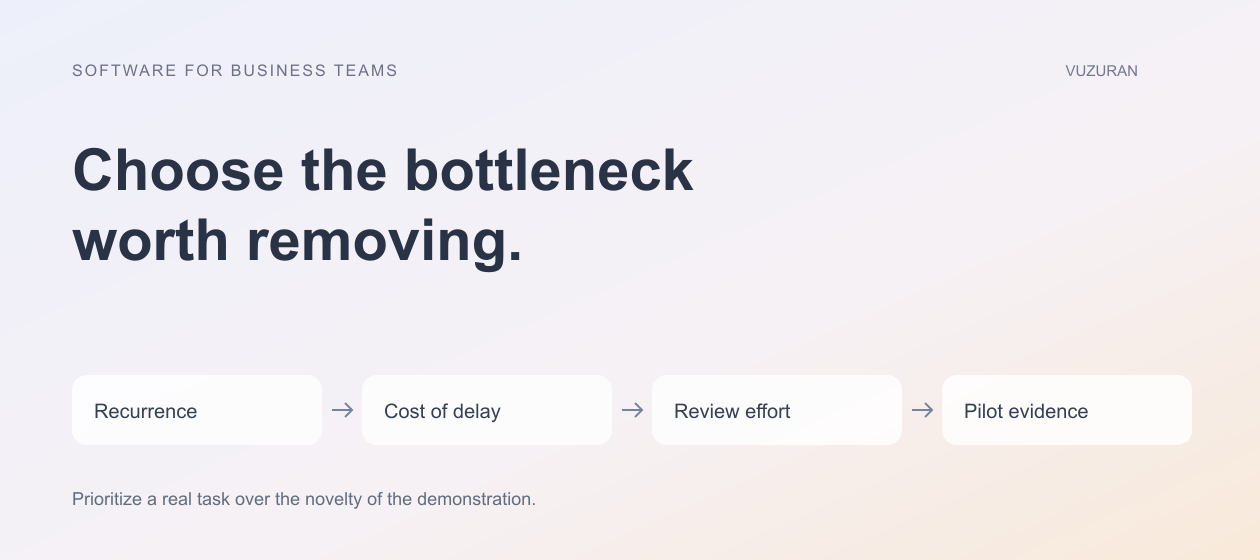
Score the bottleneck, not the novelty
Use a small scorecard to compare candidates. The values should come from observation or be labeled as estimates. A rough, honest baseline is more useful than an invented precision score.
| Dimension | Question to answer | Evidence to collect |
|---|---|---|
| Recurrence | Does the task happen often enough to matter? | Recent examples and approximate frequency |
| Delay | What waits while this task is unfinished? | Queue age and downstream impact |
| Rule clarity | Can the team explain a correct result? | Accepted examples and exceptions |
| Reversibility | What happens if the output is wrong? | Correction path and consequence |
| Review effort | Who checks the result, and how long does it take? | A measured pilot review sample |
| Integration readiness | Can the required systems be accessed reliably? | Confirmed permissions and test connection |
Avoid a single total that hides an unacceptable condition. A candidate with high potential benefit but no authorized data access is not ready simply because its other scores are attractive.
Prefer a pilot with a visible finish line
Choose one task whose completion can be checked. For example, prepare an internal summary and proposed owner for a new inquiry. Keep the original request visible and let the team confirm the assignment.
Do not start with an instruction to “run sales” or “manage operations.” It leaves too many decisions undefined and makes failure difficult to diagnose. A narrow workflow can still have meaningful business value if it addresses a frequent bottleneck.
The first pilot should make one real job easier to finish, with a result the team can inspect.
Define the cases where the system should stop. Missing information, unclear ownership or an unsupported request can produce a review item rather than an invented answer.
Remove avoidable complexity before adding a model
Sometimes the fastest improvement is a required form field, a clear assignment rule or a standard template. Use those changes where they solve the problem. A model is most useful when the task involves interpreting variable language or preparing a draft from context.
Anthropic's architecture guide recommends beginning with a simple solution and adding complexity when the task warrants it. The article is an architectural reference, not a current product comparison. Apply the principle to your workflow rather than copying a particular stack.
Our agents-versus-workflows guide provides a practical way to decide which steps need flexible interpretation and which should remain explicit rules.
Count the work that remains after automation
A draft that takes seconds may still require ten minutes of checking. Include review, correction, failed runs and maintenance in the business case. If the task becomes faster but the team does not reduce spending, describe the benefit as capacity rather than cash saved.
For a hypothetical comparison, suppose a weekly task takes 60 minutes. Automation reduces preparation to 15 minutes but adds 20 minutes of review and five minutes of exception handling. The relevant operating effort is 40 minutes, before any maintenance or provider cost. The exact result for your business requires measurement.
Our ROI guide explains how to keep those assumptions visible. Do not present a planning estimate as an observed result.

Give the pilot an owner and a stop rule
Name the person who reviews outputs and investigates problems. Define when the pilot will be paused, such as a permission failure or repeated unsupported answers. Make sure the original manual process remains available while the new workflow is being evaluated.
Keep a record of what changed: prompts, tools, sources and application behavior. A result cannot be reproduced if the team does not know which configuration produced it.
Review the pilot against the original task, including difficult examples. A founder's enthusiasm for a demonstration should not be the only acceptance criterion.
Expand along the workflow
If the first pilot works, examine the next handoff. A useful summary may expose that the real delay is approval or access to a destination system. Solve that next constraint instead of adding unrelated features because the model can generate them.
Preserve the earlier acceptance tests when expanding. A new integration should not weaken the original permission boundary or create duplicate actions. Keep the operating process understandable to the team that will run it.
VUZURAN builds AI agents, custom B2B tools and connected software. A discovery call can start with your task inventory and scorecard. We can help assess whether a process change, existing tool or custom workflow is appropriate for the first release.
Frequently asked questions
Which task should a founder automate first?
Choose a recurring, consequential task with a clear correct outcome, available data and manageable review. The most impressive demo is not necessarily the best first pilot.
Should we automate an unclear process?
Clarify ownership and rules first. Otherwise, the automation may reproduce inconsistent decisions faster without resolving the underlying problem.
Can we assume time saved equals money saved?
No. Time can create useful capacity without reducing expenses. State the benefit accurately and include review and maintenance effort.
When should we stop a pilot?
Use pre-agreed criteria, including unacceptable permission or action failures. Pause when the evidence shows the workflow cannot meet its boundary or operating requirements.
Sources & context
- Anthropic: Building effective agents
Primary reference reviewed October 27, 2026. Public-service methodology is identified as such; business frameworks and examples are original VUZURAN editorial guidance.
Written by VUZURAN. Examples labeled hypothetical are illustrative; they are not customer results. VUZURAN service references describe our own business.