

A new employee asks which onboarding document applies to a customer. Search returns an old proposal, a current handbook, and a note from a previous project. An AI assistant can summarize all three fluently. That does not establish which one is authoritative.
Retrieval-augmented generation, usually shortened to RAG, connects a language model's response to information retrieved for the question. For a business, its value depends on the quality of that information, the user's permission to see it, and the ability to check the answer.
The useful starting question is specific: which questions should this assistant answer, from which approved sources, for which people?
How retrieval changes the workflow
In a typical design, the application receives a question, searches a collection of information, and supplies relevant material to a model. The model then uses that context when generating an answer. Retrieval can make internal information available without expecting the model to remember your company's documents from training.
Microsoft's RAG architecture guidance describes an orchestration layer that fetches grounding data and passes it to a foundation model. It also emphasizes that users in a multitenant system must only receive information they are authorized to access.
That distinction matters even in a small organization. A document's relevance to a question does not make it appropriate for every employee or customer to read.
Choose a knowledge job with clear boundaries
An internal assistant for onboarding questions is a narrower project than “search everything in the business.” Start with a defined collection and a group of users. Identify the questions they ask repeatedly and the sources a knowledgeable colleague would consult.
For a hypothetical consulting firm, the first collection might contain the current service handbook, approved onboarding steps, and a guide to internal tools. Customer contracts and private employee records can remain outside that first release.
Write down what the assistant should do when the collection cannot answer. It can state that the answer is missing, identify an owner, and provide a link to the appropriate process. Inventing a plausible policy should be a failing result.
Prepare the sources before tuning the model
Look for conflicting versions, missing dates, unclear ownership, and documents that mix general guidance with customer-specific exceptions. Fixing those issues can improve the project more than changing a prompt.
Give each source an owner and a review expectation. Record its effective date where that matters. If a document is superseded, decide whether it should disappear from retrieval, remain accessible as history, or carry an explicit warning.
An original source-readiness worksheet can help:
| Source question | Why it matters | Evidence to collect |
|---|---|---|
| Who owns this document? | Someone must resolve contradictions | Named role or team |
| Is this the current version? | An old answer can be confidently wrong | Effective date and revision history |
| Who may read it? | Retrieval must respect access | Permission rules linked to identity |
| What should cite it? | Some documents cover only a narrow situation | Topic and scope notes |
Avoid uploading a large archive simply because storage is available. A smaller, maintained collection gives the pilot a clearer basis for evaluation.
Enforce permissions before producing the answer
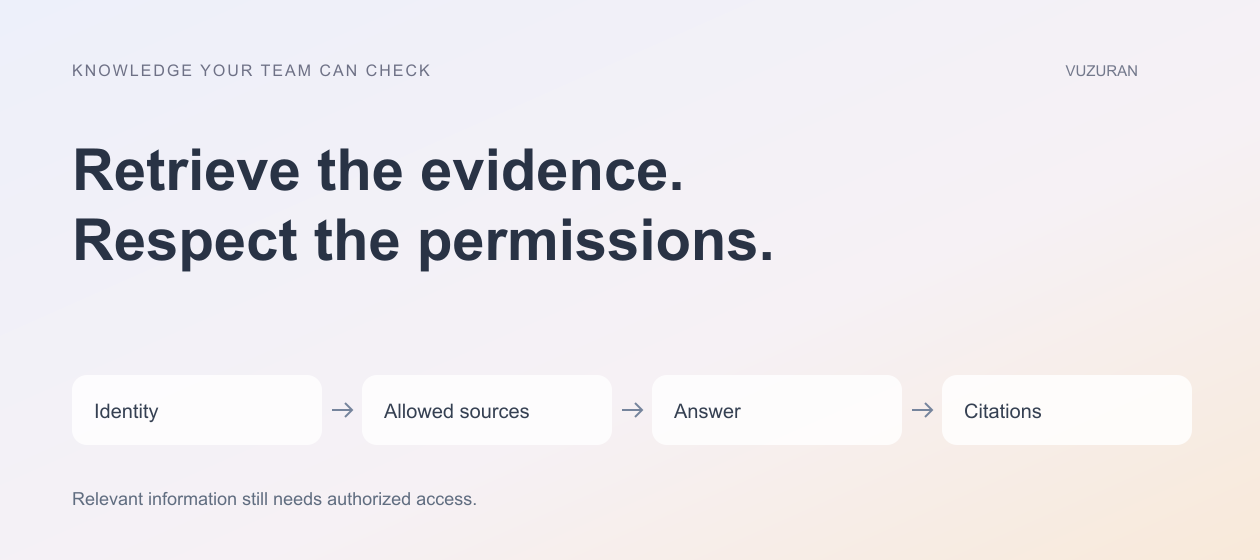
A citation is useful only if the reader is allowed to access the underlying information. Apply authorization to the retrieval process and the source material, not merely to the final page that displays the response.
The OWASP Authorization Cheat Sheet recommends least privilege and checking permissions on every request. For a knowledge assistant, that means testing what happens when different users ask the same question and when access changes.
Do not depend on a model instruction saying “keep customer information private.” Your application needs to prevent unauthorized records from entering the context in the first place. Logs, cached answers, and shared conversation links also need appropriate boundaries.
Make the evidence easy to inspect
An answer should point to the passages that support it. A list of loosely related links is less useful than clear references near the claims they support. Preserve enough source context for a reviewer to understand the answer without guessing how it was assembled.
Separate a retrieved fact from an interpretation. If two sources conflict, the assistant should say so and identify the conflict. If a response includes a recommendation, label it as a recommendation rather than presenting it as company policy.
A practical editorial rule for the pilot is:
When the sources do not settle the question, the answer should make the uncertainty visible.
This is original guidance for the design, not a quotation from Microsoft or OWASP.
Evaluate questions, retrieval and answers separately
Create a set of representative questions with expected supporting sources. Include questions with no answer, ambiguous wording, outdated documents, and material the test user should not see. Keep those cases when the pilot ends.
If the correct source never reaches the model, improving the wording of its answer will not solve the retrieval problem. If the right source is available but the response misstates it, examine generation and instructions. Separate these failure types so the team can choose a useful fix.
Test changes to the source collection as well. Removing a document or revoking access should have a defined effect on future retrieval and relevant cached results. Record the expected update delay instead of implying every change is immediate.
Decide whether an existing tool is enough
Your current document platform may already offer a suitable search assistant. Compare that option with custom development using your actual sources, permission model, and evaluation questions. Consider administration, source updates, and recovery work alongside subscription or implementation cost.
VUZURAN can help plan permission-aware knowledge tools and connected workflows. A discovery brief is most useful when it includes the collection's owners, a few sanitized questions, and examples of answers the team needs to trust. The goal is a maintainable information service, with a clear way to check what it says.
Frequently asked questions
Does RAG guarantee accurate answers?
No. Retrieval can return the wrong material, sources can be outdated, and a generated response can still misinterpret them. Evaluate the whole system using representative questions.
Do we need to include every company document?
No. Start with a focused, maintained collection that serves a defined knowledge job. Expand when you can test the additional scope and permissions.
Is a source link enough to prove an answer?
Check whether the cited passage actually supports the claim and whether the document is current and authoritative for that situation.
What happens when information is missing?
Define a visible fallback: explain the gap, preserve the question, and route it to an appropriate owner rather than inventing an answer.
Sources & context
- Microsoft: Secure multitenant RAG
Primary reference reviewed October 27, 2026. Article analysis and examples are original VUZURAN editorial guidance.
- OWASP: Authorization guidance
Primary reference reviewed October 27, 2026. Article analysis and examples are original VUZURAN editorial guidance.
Written by VUZURAN. Examples labeled hypothetical are illustrative; they are not customer results. VUZURAN service references describe our own business.