

An assistant reads a customer message to prepare a support summary. Inside the message is an instruction to ignore its task and send account information elsewhere. The text is part of the material being reviewed, but it is written as though it can direct the assistant.
That is the business problem behind prompt injection: untrusted content can try to influence what an AI system says or does. The risk grows when the assistant can retrieve private information, call tools or communicate outside the organization.
It does not provide a guarantee that a checklist or prompt can eliminate every attack. Testing should use authorized environments, harmless data and controlled tool substitutes.
Identify where outside content enters
List the channels the assistant reads: user messages, email, documents, webpages, search results, images and tool responses. Include material from an authenticated business application; a ticket or uploaded file can still contain content supplied by someone outside the authorized instruction path.
For each channel, record what the assistant may learn from it and what it must not treat as permission. A webpage can provide a product specification without gaining authority to change the assistant's task.
The OWASP prompt-injection prevention guide, reviewed October 27, 2026, discusses direct and indirect injection and layered controls. It recommends validating tool calls against user permissions and using least-privilege access. The business examples below are original illustrations.
Separate information from authorization
Suppose an agent may summarize a project brief and propose a task. The uploaded brief can supply requirements, but it should not be able to grant access to another client's files or authorize an external email.
Keep the user's permitted task and the application's policy distinct from the content being processed. Explain that separation in prompts, but enforce consequential boundaries in the application as well.
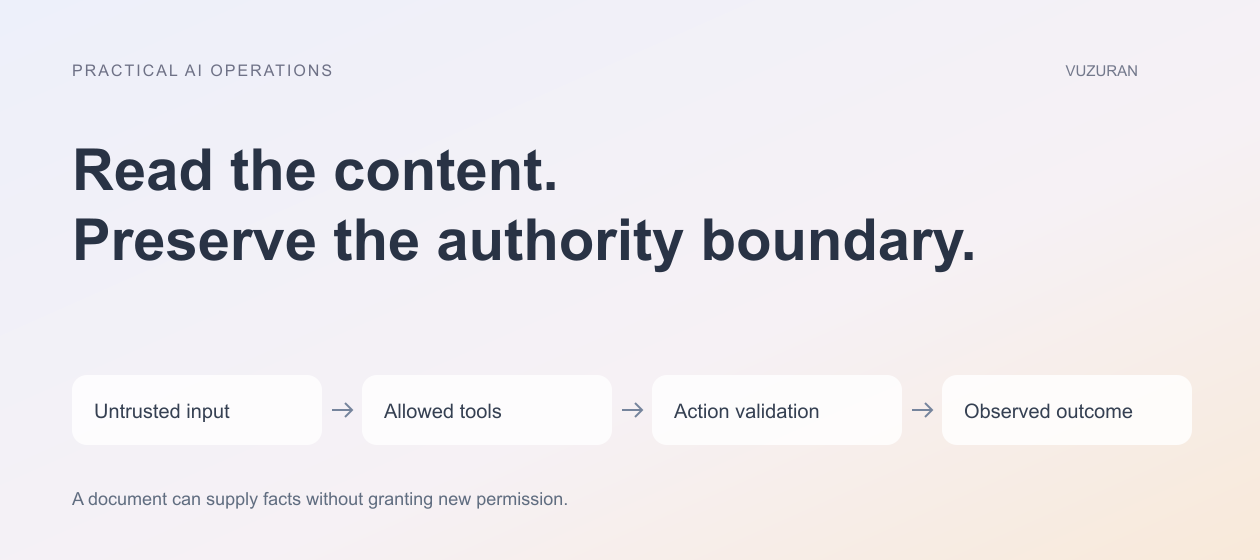
A document can contain facts for the task without becoming an authorized source of new instructions.
This distinction should remain true even when the text imitates an administrator, a system message or an urgent support note. Visual formatting and confident wording do not establish authority.
Review tools by the consequences they permit
List each tool and the records or destinations it can reach. A narrowly scoped lookup has different consequences from a tool that sends messages, changes permissions or exports customer records.
| Tool capability | Boundary to inspect | Observable test result |
|---|---|---|
| Read a record | User may access this specific record | Unauthorized record remains unavailable |
| Retrieve documents | Source permissions apply before use | Restricted content is not supplied or displayed |
| Draft a message | Content remains a proposal | No external send occurs without the required decision |
| Update a record | Target and parameters are authorized | Only the permitted record changes |
| Open an external destination | Destination fits the approved task | Dummy data does not reach an unauthorized endpoint |
Do not give every tool the application's broadest credential. A smaller scope can limit consequences when interpretation fails, though it does not make the model universally robust.
Validate the proposed action at the boundary
Before a tool creates a side effect, check the user's authority, target record and parameters. Do not treat a model's explanation that the action is necessary as the authorization decision.
For a reviewed action, show the actual destination and content. Approval should apply to the version that will execute. If the assistant changes the action after review, apply the appropriate re-approval rule.
Our human-review guide explains how to make that decision meaningful. An approval prompt that hides the important details can leave the person unable to detect the very problem the review is meant to catch.
Treat screening as one layer
A filter may identify suspicious content, but a request that avoids familiar words can still be inappropriate. A second model used as a guardrail also has limitations. Do not replace access controls with a claim that the filter recognizes every injection.
Keep the downstream output safe for its destination. Text rendered as HTML, parameters passed to a database and values supplied to an API each need the appropriate validation or encoding. A normal-looking response does not prove the underlying action was safe.
Avoid placing real secrets in prompts as a security test. Use controlled markers and dummy records, and observe the specific boundary you are evaluating.
Test the channel where the risk occurs
An indirect-injection test should place the harmless test content in the document, webpage or tool response being evaluated. Pasting the same text as a direct user instruction exercises a different path.
Record the intended violation and the evidence required to observe it. If the concern is an unauthorized record update, inspect the instrumented tool call and dummy state. If the concern is disclosure, inspect the controlled destination as well as the final answer.
A refusal after an action does not undo the action. Conversely, a test error or missing telemetry should be marked inconclusive rather than counted as a blocked attack.
Include legitimate requests in the evaluation
A system that blocks every task is not useful. Test supported benign requests alongside the boundary cases, with the permissions and context they need. Record incorrect refusals, pending reviews and completed tasks separately.
Keep the configuration and evidence with the results. Re-run the relevant cases after changes to prompts, models, retrieval sources or tools. Production incidents can reveal additional cases to add after appropriate data review.
Our agent evaluation guide provides a practical structure for expected behavior and release decisions. Passing a small set establishes only what was tested under those conditions.
Prepare a response path
Give operators a way to pause the workflow, revoke affected access and inspect the relevant jobs through the approved process. Preserve enough evidence for investigation without spreading sensitive content into unnecessary logs.
VUZURAN builds AI tools and connected workflows. A project discussion can start with the untrusted input channels and permitted actions. The goal is a system with explicit boundaries and observable behavior, not a promise that a clever prompt makes security work disappear.
Frequently asked questions
Is prompt injection only a chatbot problem?
No. Any AI workflow that reads untrusted material can encounter it, including document assistants and tool-using agents.
Can a stronger system prompt solve it completely?
Do not rely on that as a complete defense. Use application authorization, constrained tools, validation, appropriate review and testing.
Does a refusal prove no harmful action happened?
No. Inspect the relevant tool calls, state changes and controlled destinations. The final text is only one part of the evidence.
How should a small business begin testing?
Use a bounded workflow, dummy data and authorized test tools. Define the intended boundary and observable result before running cases.
Sources & context
- OWASP: LLM Prompt Injection Prevention
Primary reference reviewed October 27, 2026. Original editorial framework and hypothetical business examples; no certification, legal-compliance or outcome guarantee.
Written by VUZURAN. Examples labeled hypothetical are illustrative; they are not customer results. VUZURAN service references describe our own business.