

Before a customer call, a founder has a short window to answer three practical questions: what has changed, what does the customer need to decide, and what should we ask? A long account summary can consume that window without making the conversation better.
ChatGPT can help assemble and organize permitted account context. The useful outcome is a brief that helps the person taking the meeting make decisions. It should make the evidence and its limits visible, rather than turn a collection of notes into an apparently certain story about the buyer.
OpenAI's meeting-preparation use case describes gathering approved meeting context and drafting a preparation packet. The workflow below is an original adaptation for a small B2B team, with a specific focus on uncertain account information and customer-facing commitments.
Decide what the call is for
Name the decision or learning objective before collecting material. An introductory call, a technical review, and a renewal conversation need different preparation. Asking for the same generic account profile before each one can bury the useful details.
For a hypothetical software-services company, the objective might be to determine whether a prospect's lead-routing problem is defined well enough for discovery. The brief should prepare the founder to ask about ownership, source systems, and exceptions. It should not assume the prospect needs a custom AI agent.
Write the objective at the top of the brief. Use it to decide which information to leave out. A fact can be accurate and still be irrelevant to the conversation you are about to have.
Choose the account record carefully
Confirm the company and the specific people attending. Similar names, subsidiaries, old contacts, and forwarded invitations can lead to the wrong context. Use stable account identifiers where your tools support them.
Identify the records that are appropriate for this meeting: the current inquiry, permitted CRM notes, an agreed proposal, or a recent customer email. Avoid adding unrelated private records just because a connector can search them.
If you use connected applications, confirm the authorized identity and access. A prepared brief should not silently rely on information the meeting participant is not entitled to see or share.
Build a fact-and-hypothesis ledger
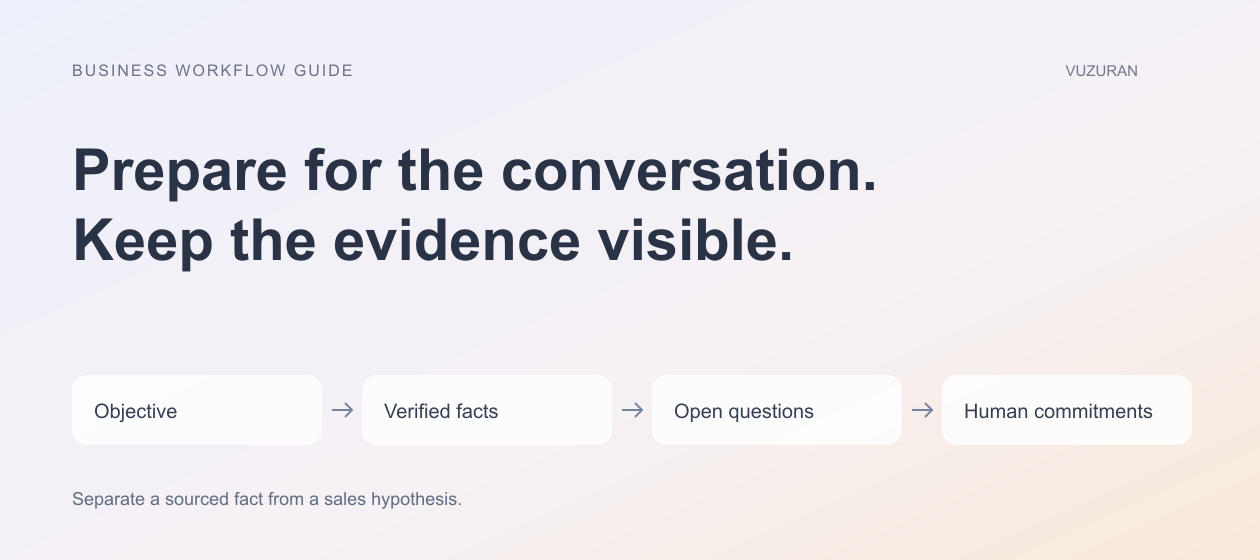
An inference about a buyer is not an account fact. Keep those categories separate. A customer saying that a manual process takes too long is evidence of a stated problem. It does not establish their budget, purchasing authority, or readiness to buy.
A compact ledger can make the distinction visible:
| Item | Example in the hypothetical brief | Treatment |
|---|---|---|
| Confirmed fact | The inquiry asks about assigning leads between two teams | Link to the inquiry |
| Unverified assumption | One CRM is the main source of truth | Turn into a question |
| Potential risk | Two departments may maintain conflicting records | Explain the basis and ask for clarification |
| Missing information | No process owner has been named | Flag before proposing scope |
The examples are invented for explanation. They are not VUZURAN customer records or a claim about any real buyer.
Give ChatGPT a bounded writing task
Use instructions that specify the purpose and the treatment of uncertainty. Here is an original prompt you can adapt after checking your organization's data rules:
Prepare a short internal brief for this call's decision: [decision]. Use the attached, approved account material. For each material claim, identify the supporting record. Put assumptions and missing details in a separate section. Suggest questions that could change our understanding of the problem. Do not infer budget or buying authority from a job title, and do not send or update anything outside this draft.
This is an instruction for preparation, not a promise about model behavior. Review the output against the actual records. If the model cannot access a source, ask it to state the gap instead of treating another document as an equivalent substitute.
Use questions that could change the recommendation
A useful question helps the team decide what to do next. “How are inquiries assigned today?” can reveal whether the bottleneck is a missing rule, an integration gap, or disagreement about responsibility. Each answer could lead to a different solution.
Avoid questions designed only to steer the prospect toward a preselected product. The brief should help the founder understand the business process, including reasons a custom project may be unnecessary.
Choose a small number of questions and explain why each matters. The person taking the call can then follow the conversation naturally rather than read a generated questionnaire in sequence.
Check the brief before the meeting
Open the sources for important claims. Check names, dates, the current proposal version, and any statement about an earlier commitment. Remove speculative personal details that do not serve the legitimate business purpose.
Look for contradictions. An old CRM note may say a project is paused while a recent email asks to restart. The brief should explain the difference rather than combine both into a confusing summary.
Also check the sharing destination. An internal risk assessment may be appropriate for the seller and inappropriate for a customer-facing pre-read. Prepare separate artifacts when the audiences need different information.
Start manually before creating a recurring agent
A recurring preparation workflow can be useful for a team with many similar meetings. OpenAI's workspace-agent example demonstrates that kind of arrangement. Before scheduling your own version, test whether the brief helps the actual person taking the call.
Define which meetings qualify and how to handle canceled or rescheduled events. Decide whether an updated brief replaces the old one or creates a new revision. An automatic process should not leave several contradictory documents with equally authoritative names.
Measure preparation effort and correction effort together. The goal is to arrive informed, with less reconstruction work, not to generate the longest account document.
Connect preparation to an agreed next step
After the call, compare the brief's assumptions with what you learned. Confirm any new commitment before updating the account or sending a follow-up. Keep a source trail for important changes.
VUZURAN can help connect account preparation, reviewed follow-up, and internal project workflows. Bring the systems you already use and a sanitized example to a discovery conversation. The first improvement may be a better brief and handoff, rather than a broad sales automation project.
Frequently asked questions
Can ChatGPT research a prospect for me?
It can help organize information from available, permitted sources. Verify important details and avoid treating generated interpretations as established facts about a person or company.
Should the brief include a proposed price?
Only if an authorized, current source supports it and that information is appropriate for the meeting. Do not infer a quote from a general service description.
How long should the brief be?
Use the shortest format that supports the call's objective. Keep background links available without forcing the reader to work through every source before the meeting.
Can this run automatically before calls?
That depends on your tools and permissions. First test the manual workflow, then define qualifying meetings, updates, output access, and the person responsible for exceptions.
Sources & context
- OpenAI: Meeting preparation briefs
Primary documentation reviewed October 27, 2026. Examples and analysis are original VUZURAN editorial guidance.
- OpenAI: Sales meeting preparation with ChatGPT agents
Primary documentation reviewed October 27, 2026. Examples and analysis are original VUZURAN editorial guidance.
Written by VUZURAN. Examples labeled hypothetical are illustrative; they are not customer results. VUZURAN service references describe our own business.