

A workflow fails and the team presses Retry. Sometimes that is enough. Sometimes the source data is still invalid, the credential is still expired or the first attempt already changed the external record. Repeating the same operation can leave the problem untouched or make it worse.
AI workflow reliability depends on recognizing what kind of failure occurred and choosing the appropriate response. The language model is one component among source systems, permissions, application logic and human decisions.
This guide offers an original operating framework. It does not promise zero downtime or a universal retry setting. Use the actual provider behavior and the consequences of the workflow to define recovery.
Define the business outcome
Write the state that means the job is complete. For an inquiry workflow, that may be an owned task confirmed in the CRM. For a document workflow, it may be a validated record exported to the intended destination.
Keep intermediate outputs separate. A generated summary, approved draft or successful network connection may be necessary without establishing completion. Monitoring should show the actual work still owed to the user.
Our agent monitoring guide explains how to connect technical traces to business events. Start with that map before choosing alert thresholds.
Use a failure taxonomy the team can act on
Group failures by the response they require. A useful category tells the operator what evidence to inspect and whether a repeated attempt can help.
| Failure category | Example | Likely next step |
|---|---|---|
| Invalid input | Required customer identifier is missing | Correct or request information |
| Authorization | Credential lacks the intended access | Review the permission through the approved process |
| Temporary dependency issue | A permitted service is briefly unavailable | Apply the bounded retry policy |
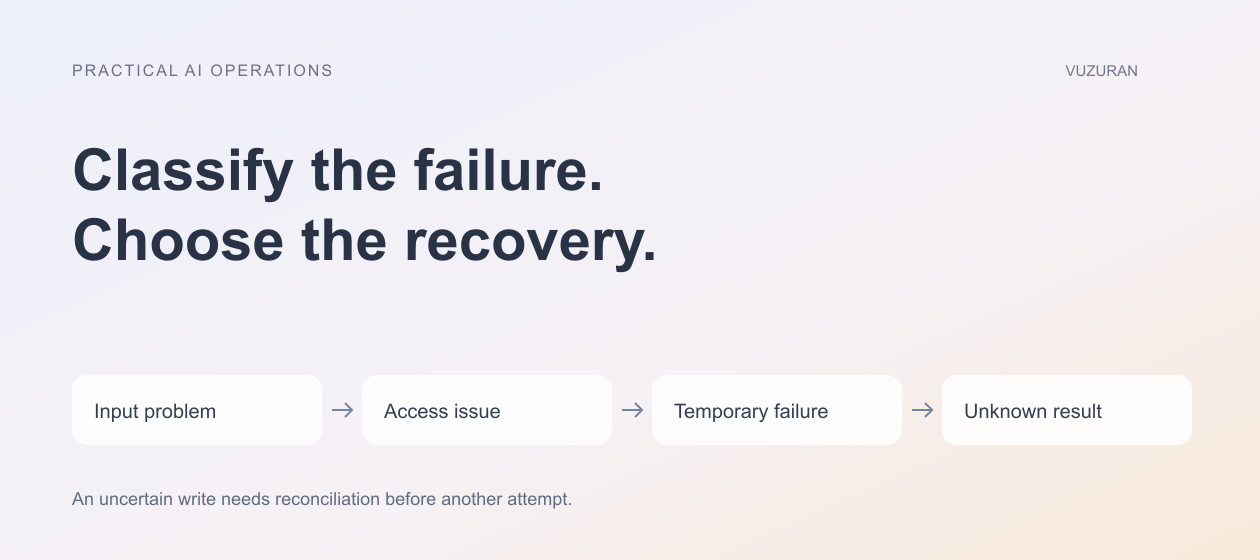
| Uncertain external result | Write may have succeeded before a timeout | Reconcile destination state |
| Unsupported model output | Proposed answer lacks evidence | Review source or route for correction |
| Business exception | Request falls outside the defined process | Handoff to an accountable person |
These categories are a starting point. Refine them using actual failures rather than force every incident into a generic “AI error.”
Distinguish failure from uncertainty
A rejected write and a lost response are different states. If the destination accepted a request before the connection failed, a repeated creation call can produce another record or message.
When the result is unknown, investigate the result before repeating the action.
Use a stable business operation identifier and preserve the relevant destination reference. Where the provider supports idempotency, follow its documented semantics. Otherwise, design a suitable reconciliation or duplicate-prevention process.
Our API integration guide develops this case in more detail. Do not turn every timeout into a definitive failure merely because the application needs a simple status label.
Keep retries bounded and coordinated
AWS's timeouts, retries and backoff article, reviewed October 27, 2026, explains that retries can amplify load on an already struggling service and that side effects need care. It is an architectural reference, not a ready-made configuration for your application.
Choose which errors are eligible for retry, how many attempts are permitted and what happens afterward. Account for retries already performed by a client library or another layer. Several independent retry loops can create more attempts than the operator expects.
Use the provider's documented limits and observed response behavior. A universal delay copied from an example may be inappropriate for the actual task or dependency.
Validate model output before action
A response can arrive successfully while failing the business requirement. Check required structure, allowed values and supporting evidence before passing output to a tool or user-facing destination.
If the model lacks necessary information, route the gap for clarification rather than ask it repeatedly until a plausible answer appears. Repetition is not a substitute for missing evidence.
Keep deterministic validation outside the model where practical. A required record identifier, authorized destination or allowed status value should not depend solely on the model explaining that it chose correctly.
Make partial completion visible
A multi-step workflow may create a record and then fail to send its notification. Record the completed action and the unfinished one separately. Do not restart the entire sequence without checking what already happened.
Define whether later failures require a compensating action, manual review or simply completion of the remaining step. The correct response depends on the business process; undoing an earlier action is not always appropriate or possible.
Give the operator a concise account of the last verified state and the available recovery options. Avoid requiring them to infer this from a raw stack trace.
Provide a safe pause and manual fallback
The team should be able to stop new automated actions while preserving incoming work and evidence. Decide who can pause the workflow and how the manual process handles pending items.
When service resumes, reconcile the backlog before replaying it. A teammate may have completed some work manually during the outage. Preserve those interventions so the automation does not duplicate them.
Test this process in an authorized environment. A runbook that nobody has exercised may omit the credential, file or decision needed during a real incident.
Turn incidents into regression cases
Record the cause, affected business work and verified correction. Add a representative case to the evaluation set after removing unnecessary sensitive information. Re-run it when the relevant component changes.
Measure recovery effort, duplicate actions and unfinished jobs as well as availability. A workflow that stays online but repeatedly needs invisible manual repair may not be reliable enough for the intended role.
VUZURAN develops custom AI tools and connected business software. A project discussion can start with the failure categories and recovery responsibilities in your current process. The aim is a workflow whose problems are visible and recoverable, with claims matched to actual evidence.
Frequently asked questions
Should every error trigger an automatic retry?
No. Invalid input, denied access and uncertain external actions need different responses. Define which failures are genuinely eligible.
Does a successful model call prove the workflow succeeded?
No. Validate the output and verify the required business outcome in the destination system.
What is partial completion?
It means some steps finished while others remain unresolved. Preserve that state so recovery does not repeat actions unnecessarily.
What should an incident log contain?
Record the affected job, last verified state, cause, response and evidence of correction. Keep sensitive content out unless it is necessary and appropriately protected.
Sources & context
- AWS: Timeouts, retries and backoff with jitter
Primary reference reviewed October 27, 2026. Original editorial framework and hypothetical business examples; no certification, legal-compliance or outcome guarantee.
Written by VUZURAN. Examples labeled hypothetical are illustrative; they are not customer results. VUZURAN service references describe our own business.