
A business owner rarely arrives with a complete software specification. More often, there is an awkward process: requests get copied between tools, a customer waits for a reply, or a staff member spends Friday assembling the same report. The first job is to understand that process well enough to decide what should change.
VUZURAN is a software company working on AI agents, custom business tools, and connected workflows. This article explains the project questions we consider useful before development. It describes an approach to scoping and evaluating work, not a claim that every engagement includes an identical package or a guaranteed result.
Begin with the work people actually do
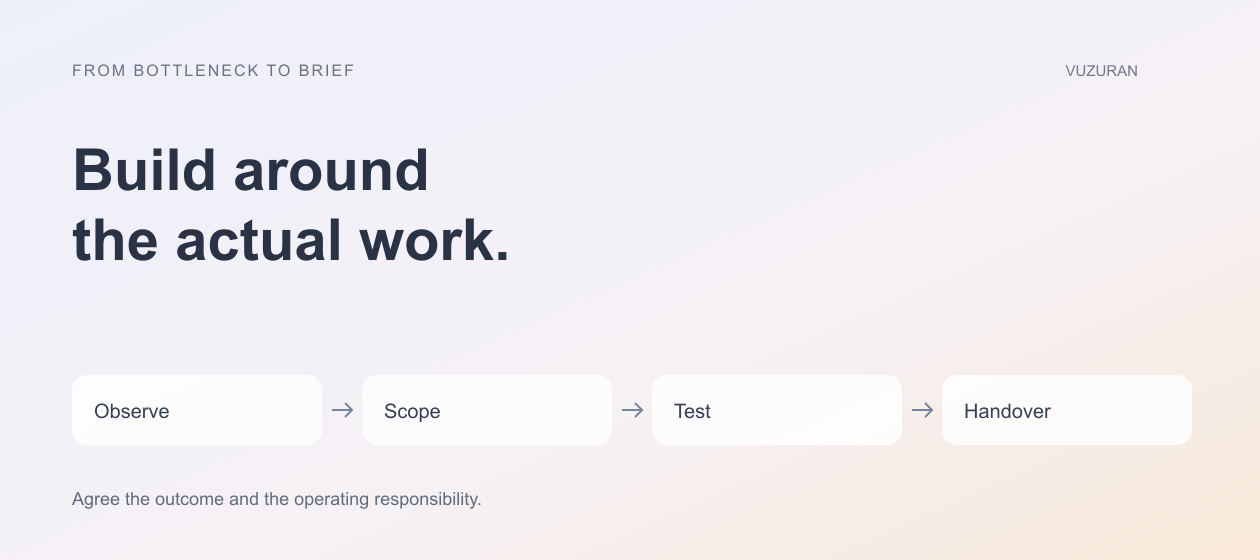
A useful brief starts with a recent example. What triggered the task? Who handled it? Which systems did they open? Where did they wait, and what did they check before calling it complete?
Bring a sanitized example rather than a folder of private customer information. A short walkthrough can reveal whether the problem is missing data, unclear ownership, disconnected tools, or a decision that genuinely needs interpretation. Those distinctions affect the solution.
The first outcome should be a shared description of the bottleneck. “Reduce time spent preparing the weekly customer report” is a starting point. It becomes more useful when the team defines which report, which sources, who reviews it, and how an acceptable version differs from an unacceptable one.
Decide what needs custom software
An existing feature may solve the problem. A form rule, a saved report, or a straightforward integration can be enough. Custom development is relevant when the requirements do not fit an available product well, the handoffs cross several systems, or the user experience needs to reflect a specific operating process.
AI adds value where interpreting or generating information helps the task. It also introduces output that needs evaluation. We should be able to explain why a particular step uses a model and what happens when that step is uncertain.
The project should have a useful business outcome even when the AI component is described in ordinary language. If the only clear requirement is “add AI,” discovery has more work to do.

Define the first release
A focused release has explicit boundaries. Identify the people using it, the actions it can perform, and the systems it connects. State what remains manual and what falls outside the release.
Consider a hypothetical service company improving inquiry handling. The first release might validate submissions, suggest a category, prepare a reply, and route it to a reviewer. Automatic customer commitments, financial adjustments, and a complete CRM replacement could remain outside scope.
This is an illustration, not a standard VUZURAN package. The right boundary depends on the actual process and the team's ability to operate the result.
| Brief section | A useful answer | A question still needing discovery |
|---|---|---|
| Trigger | A valid website inquiry arrives | Which forms and channels are included? |
| Outcome | An assigned reviewer receives a prepared response | What must the reviewer check? |
| Sources | Approved service information and permitted CRM records | Who owns outdated or conflicting information? |
| Exceptions | Missing information enters a review queue | Who handles the queue during absences? |
| Acceptance | Agreed examples meet defined criteria | What errors require a pause? |
Make permissions part of the specification
Access should be scoped to the job. A system that drafts a response does not automatically need authority to send it. A customer-facing screen should not expose another customer's files because a record identifier is easy to guess.
The OWASP authorization guidance is a useful technical reference for least privilege and request-level checks. In project planning, those ideas become concrete questions about user roles, permitted records, and who can approve an action.
Document how access is granted, changed, and removed. Include administrators and support staff in that discussion. The operating team needs enough access to investigate failures without receiving unrelated private data by default.
Agree how the result will be tested
Create acceptance examples before development finishes. Include common inputs and difficult cases: incomplete requests, duplicate submissions, unavailable systems, and information the user is not allowed to access.
A test should describe the expected behavior. “Works well” is hard to verify. “A repeated submission does not create a second outbound message” gives the team a specific result to examine.
For AI output, evaluate accuracy, evidence, and restraint alongside tone. A polished response that invents a service or promises an unapproved deadline should fail. Keep the examples so later changes can be checked against the same requirements.
Plan the interface around decisions
A dashboard should help someone understand the state of the work. Show what is waiting, what needs review, and what has completed. An error should lead to a useful next step rather than an unexplained red banner.
Ask which information the operator needs at the moment of action. A reviewer may need the original inquiry next to the draft. A manager may need an exception count and the age of pending items. Those are different jobs and may require different views.
For the discovery brief:
The interface should make the next responsible action clear, especially when the automated path stops.
Specify handover and ongoing ownership
The project does not end with a screen recording of a successful run. Agree what the team receives: documentation, access arrangements, known limitations, deployment responsibilities, and a way to recover unfinished work. The exact deliverables belong in the engagement scope.
Connected systems change. A provider can alter an API, a staff member can leave, or the business can update a policy. Decide who monitors the workflow and how changes are evaluated. The NIST AI Risk Management Framework is a broader reference for treating AI risk as an ongoing management concern.
Prepare for a discovery conversation
A useful starting packet contains the process description, current tools, a sanitized example, approximate frequency, and the outcome you want. Include deadlines and constraints that could change the design. If you have an existing automation, bring a description of where it fails.
You can contact VUZURAN to discuss that brief. The conversation should clarify whether a custom project is appropriate, which assumptions need validation, and what a reviewable first release could include. Scope and responsibilities should be agreed before development begins.
Frequently asked questions
Can we start with one process?
Yes. A narrow workflow can provide a clearer basis for testing and operating a first release. The scope still needs to include the exceptions and systems that process depends on.
Do we need to know which AI model to use?
You can begin with the task and its constraints. Model selection should follow the requirements, evaluation examples, and operating considerations.
Is this a fixed service package?
No. This article explains planning questions. Deliverables, pricing, timeline, support, and access arrangements depend on an agreed project scope.
What should we avoid sending before discovery?
Use sanitized examples. Do not send credentials, private customer records, or unnecessary personal information before appropriate access and data-handling arrangements are established.
Sources & context
- OWASP: Authorization guidance
Primary reference reviewed October 27, 2026. Article analysis and examples are original VUZURAN editorial guidance.
- NIST: AI Risk Management Framework
Primary reference reviewed October 27, 2026. Article analysis and examples are original VUZURAN editorial guidance.
Written by VUZURAN. Examples labeled hypothetical are illustrative; they are not customer results. VUZURAN service references describe our own business.