
The caller asks for Thursday afternoon. The agent responds naturally and offers a time. That interaction sounds successful until Thursday arrives and the appointment is on the wrong calendar, in a different timezone, or still waiting for someone to confirm it.
A booking voice agent combines conversation with a business transaction. Speech recognition and a pleasant voice help people use it, but the appointment system determines whether the promise is real. A practical pilot should test both sides together.
The framework below is original guidance for US appointment-based businesses. It does not assume a specific voice product can perform every action described; use the checklist to verify the implementation you are considering.
Define what the agent can book
Start with one appointment type, its duration and the people or resources required. Write down opening hours, preparation time, buffers and any restrictions on same-day requests. Decide whether the workflow creates a confirmed appointment or submits a request for review.
Keep that distinction in the spoken language. “Your request has been received” and “Your appointment is confirmed” establish different expectations. The agent should not use the stronger wording because it sounds more reassuring.
Specify what falls outside the pilot. A caller asking to change an existing appointment may need identity verification or a different route. A question about a service should use approved information rather than distract the booking flow into an unsupported consultation.
Capture the appointment as structured information
Confirm the caller's name, contact method, appointment type and chosen day and time. Where a detail is unclear, ask a focused question. Avoid reading a long list of possibilities when one clarification would resolve the ambiguity.
Repeat important details before the final action. A spoken email address can be misheard, and a date such as “next Friday” can be interpreted differently depending on the caller's expectation. Give the actual date and timezone in the confirmation.
Keep a structured booking record alongside the conversation context. The calendar integration should receive a validated start, end, timezone and relevant resource identifier, not an unreviewed transcript that another system must guess how to interpret.
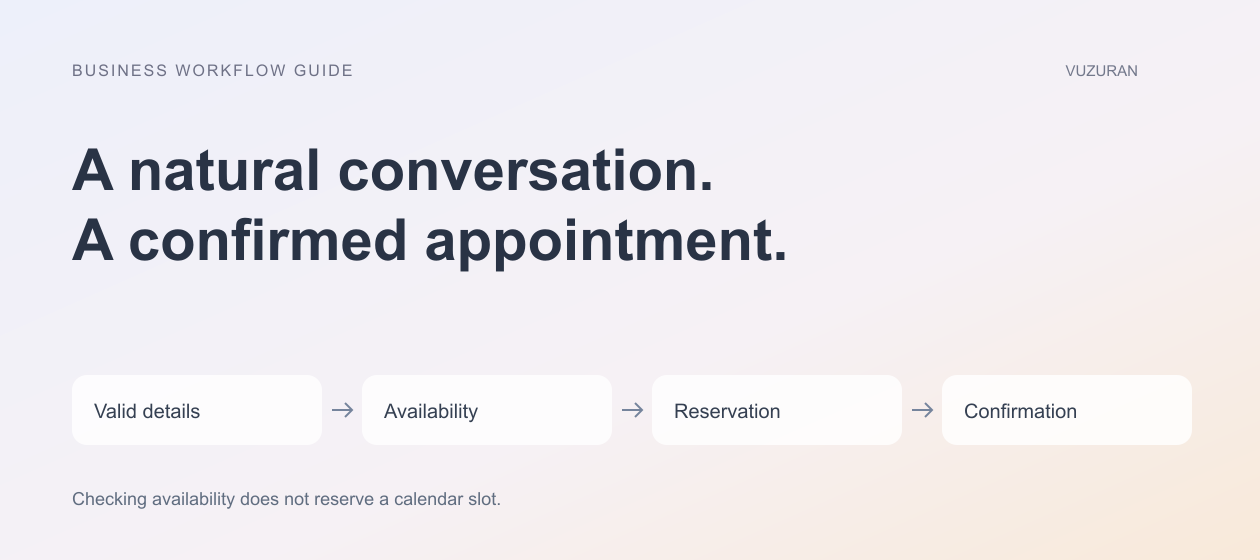
Separate availability from reservation
Google's Calendar free/busy API, reviewed October 27, 2026, returns busy intervals for specified calendars. Its event creation guide documents the separate step of creating an event. Reading availability is therefore not evidence that a slot has been reserved.
Between offering a slot and creating the appointment, someone else may take it. Decide how the booking service checks for a conflict at the final step and what it tells the caller if the slot is no longer available. Do not assume a free/busy query creates a hold.
The agent should confirm a booking only after the booking system confirms the intended appointment.
If several team members can take the appointment, document the assignment rule. “Any available person” still requires a defined pool and a check that the chosen person can perform that service.
Test timezones with actual dates
A US audience spans several timezones. Display or speak the timezone explicitly and retain an unambiguous timestamp in the booking record. Test daylight-saving transitions where they apply and callers whose timezone differs from the business.
| Test call | Expected behavior | Evidence to inspect |
|---|---|---|
| Caller requests a relative day | Confirm the actual date | Stored date matches the spoken confirmation |
| Caller is in another timezone | State the relevant timezone clearly | Calendar event and confirmation agree |
| Slot becomes unavailable | Offer a valid alternative | No overlapping appointment is created |
| Caller repeats the request | Recognize the existing booking attempt | No unintended duplicate |
| Connection fails after submission | Reconcile the result | Confirmed, pending or failed status is accurate |
These are acceptance tests, not claims that calendar software automatically handles the entire workflow. Include them in the implementation brief and keep the results.
Design for silence, interruption and uncertainty
Callers pause, correct themselves and speak over an explanation. The agent needs a way to recover without guessing. Test a changed appointment preference halfway through the conversation and a caller who cannot complete a required detail.
Offer a clear route to a person or a callback request. A handoff should include the collected details and the specific unresolved issue. The teammate should not need to ask every question again simply because the agent reached its boundary.
Decide how callers are informed that they are speaking with an automated system and how any recording or transcript is handled. Have the appropriate business owner approve those practices for the intended use before launch. This guide does not provide legal advice about calling or recording requirements.

Make retries safe
A slow calendar response can produce an uncertain state: the appointment may exist even though the voice application did not receive the result. Reconcile using a booking operation identifier before repeating the creation request.
Give the caller an accurate response while the result is unresolved. A pending request should remain pending rather than turn into a confident confirmation. Our API reliability guide explains why uncertain outcomes need a recovery path.
Also test confirmation messages. A created appointment and a delivered email are separate events. If the message fails, the system should preserve the booking and show the notification problem to the team instead of creating another appointment.
Review completed outcomes with the team
During the pilot, inspect a sample of successful calls as well as failures. Confirm that the intended service, calendar, attendee and time match what was agreed. Track manual correction effort and failed handoffs separately from call completion.
A short call is not automatically a good call. The useful measure is a correctly recorded appointment or an accurately routed request, with the caller understanding what happens next.
VUZURAN develops custom AI tools and connected workflows. A booking-workflow discussion can begin with the calendar rules and confirmation boundary. A conventional booking form may be sufficient when callers do not need a voice channel.
Frequently asked questions
Does checking free/busy reserve the appointment?
No. Availability lookup and event creation are separate operations. The implementation needs an explicit conflict and reservation strategy.
Should the agent say a request is confirmed immediately?
Only after the intended booking system provides the required confirmation. Otherwise, explain that it is a request or pending action.
What should happen if the calendar connection times out?
Reconcile the result before retrying. The appointment may have been created even if the response did not reach the agent.
Is a human handoff still necessary?
Provide one for unsupported requests, unresolved details and cases that need a person. Include the context already collected so the caller does not start over.
Sources & context
- Google Calendar: Free/busy query
Primary documentation reviewed October 27, 2026. Original editorial frameworks and explicitly hypothetical examples; not provider-endorsed or measured customer results.
- Google Calendar: Create events
Primary documentation reviewed October 27, 2026. Original editorial frameworks and explicitly hypothetical examples; not provider-endorsed or measured customer results.
Written by VUZURAN. Examples labeled hypothetical are illustrative; they are not customer results. VUZURAN service references describe our own business.