

A founder asks an AI research tool which platform to buy. The answer arrives with a comparison table, a recommendation and a long list of citations. It looks ready for the team meeting. Before using it, someone still needs to check whether the prices are current, the features belong to the relevant plan and the sources support the conclusion.
Research tools can shorten the search for useful material. Their output becomes more valuable when the business has a clear method for checking it. That method does not require a large research department. It requires a question, an evidence record and an honest account of what remains unknown.
It is not a benchmark or a claim that any tool always produces reliable results.
Narrow the decision before expanding the search
“Find the best CRM” leaves too much room for a generic answer. Describe the actual decision: a team needs to route website inquiries, preserve ownership and avoid duplicate follow-ups. State the existing systems, required integrations and constraints.
Define the research period and geography where they matter. A US availability question should not be answered from a product page for a different market without checking the distinction. A current pricing question needs a current source and a clear indication of currency, billing period and plan.
Ask for unresolved questions as part of the deliverable. A useful report may conclude that a feature needs a trial or vendor confirmation. That is more actionable than converting incomplete evidence into a confident recommendation.
Understand the product's research mode
Perplexity's current Pro Search guide, reviewed October 27, 2026, describes source-linked responses and says Pro Search is used automatically in Search when included in the user's plan. Its interface guidance distinguishes a longer Deep Research report from a regular search response. The same page advises checking the linked sources.
Microsoft's Researcher guide describes reports using web and work material, with source citations and a choice of research scope. Availability depends on the applicable subscription and organizational setup.
These features are useful starting points. Their existence does not establish that a specific report is complete, current or appropriate for your decision. Evaluate the actual evidence returned.
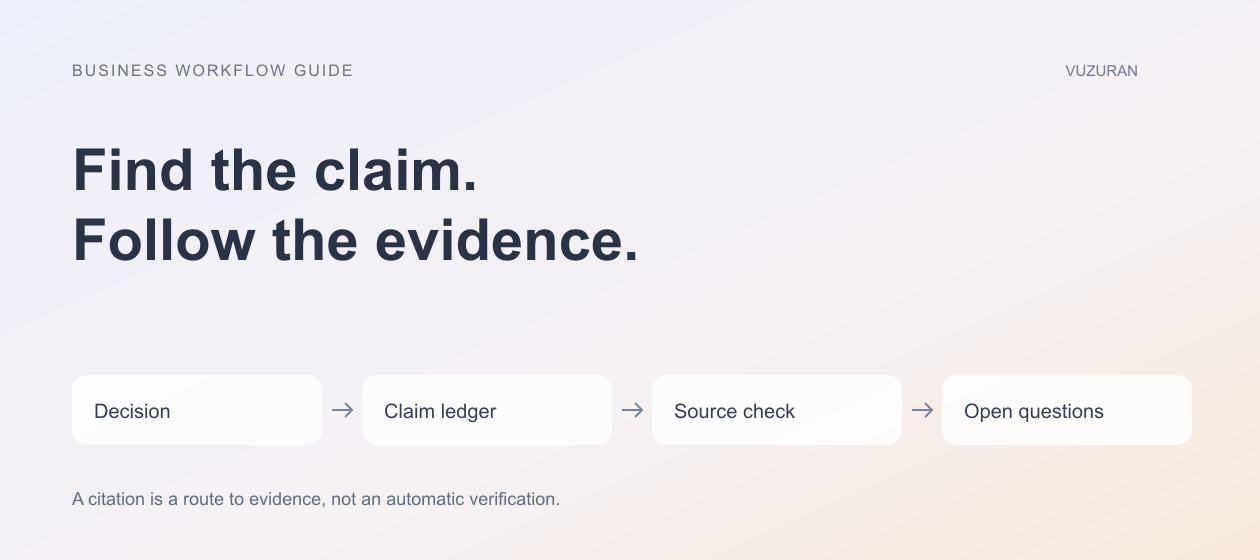
Keep a claim ledger
Create a short table that separates what the source says from what the team infers. Include a working URL and a date checked. Avoid pasting entire articles into the ledger; record the relevant fact in your own words and preserve a precise reference.
| Claim under review | Evidence needed | Status to record |
|---|---|---|
| A feature is included | Current official plan or feature documentation | Confirmed, restricted or unclear |
| A tool connects to an application | Connector documentation and required permissions | Supported in the intended setup or untested |
| A workflow saves time | Defined baseline and comparable pilot results | Observed, estimated or unsupported |
| A vendor is a good fit | Evidence against the business's requirements | Team judgment with stated trade-offs |
A citation is a route to evidence. It is not evidence that the sentence beside it is correct.
Open the important sources. Check whether the specific claim appears there, whether the page is current and whether a qualification changes the meaning. A feature described as a preview should not quietly become a generally available capability in the final brief.
Trace repeated claims to their origin
Several websites may repeat the same announcement. Treating them as independent confirmation can create false confidence. Follow the claim back to an original announcement, official documentation, published study or another identifiable primary source.
For a vendor feature, the vendor's documentation is usually the right place to establish what is offered. It is not independent proof of customer outcomes or superiority. For those questions, record the measurement method and who produced the evidence.
If the original source cannot be found, label the claim accordingly or omit it. Do not cite a secondary summary as though you reviewed the underlying research.
Test the conclusion against missing information
Ask what would change the recommendation. Perhaps a required integration needs a higher plan, the export format is unsuitable or a security review has not happened. Put those conditions beside the recommendation rather than hide them at the end.
A decision brief can be compact: the question, options, verified facts, trade-offs, unknowns and next action. The team should be able to distinguish a documented fact from an assumption without reading every research note.
Editorial principle: a useful research brief shows where the evidence stops.
When sources disagree, explain the disagreement. A current documentation page may supersede an older announcement. A region-specific page may describe a different offering. Record the reason for preferring one source, and preserve uncertainty if the evidence does not settle the issue.
Protect information when adding work files
Before uploading internal material, check the tool's terms, organizational controls and authorized use. Share only the information needed for the research question. A public product comparison rarely requires a full customer export.
For connected workplace research, verify the account and permissions used. Our internal knowledge assistant guide covers document access and source ownership. A convenient connection should not become an excuse to ignore where information travels or which generated copies remain.
Reuse the method, then refresh the facts
Save the research brief and ledger in a place the next reviewer can find. Set a review trigger for facts likely to change: a purchasing decision, plan renewal, release announcement or product migration. Do not merely replace the date on an old report.
Measure the time spent checking and correcting the output. A tool that drafts quickly but produces many unverifiable claims may create more review work than it removes. Compare results on the same question and source requirements before deciding which tool suits your team.
VUZURAN develops custom AI tools and B2B workflows. If research repeatedly feeds proposals, sales preparation or internal decisions, a project discussion can explore a reusable evidence workflow. A shared template may be sufficient when the underlying process is still simple.
Frequently asked questions
Can an AI research report replace source checking?
No. Review consequential claims against the original source, including dates, scope and qualifications. The report can help organize that work.
Are several citations always better than one?
Not if they all repeat the same unsupported claim. Source quality, relevance and independence matter more than the count.
Should every article or report use direct quotations?
Only when the exact wording adds value and can be accurately attributed. Original explanation with a source link is often clearer and avoids unnecessary copying.
How should we present uncertain findings?
Name the missing information, explain its effect on the decision and identify the next check. Do not turn an unresolved question into a factual statement.
Sources & context
- Perplexity: Pro Search
Primary documentation reviewed October 27, 2026. Analysis, examples and evaluation framework are original.
- Microsoft: Researcher
Primary documentation reviewed October 27, 2026. Analysis, examples and evaluation framework are original.
Written by VUZURAN. Examples labeled hypothetical are illustrative; they are not customer results. VUZURAN service references describe our own business.