

A business application may receive a short request to summarize a note, a difficult question about a technical document and an instruction to change a customer record. Sending all three through one identical path can waste effort or hide an important distinction. The last request involves authority as well as understanding.
Model routing assigns work to an appropriate processing path. That path might use a particular model, a deterministic rule, a human reviewer or no automated action at all. The useful goal is a reliable outcome for each kind of work, with a cost the business can justify.
It does not rank current models or promise a specific reduction in spending.
Define task classes before model tiers
Write down the jobs the application actually performs. “Easy” and “hard” are usually too vague to guide a production decision. A short message can contain a sensitive action, while a long document may require only a straightforward extraction.
Classify tasks by the evidence they need, the output they produce and what happens afterward. A draft for internal review has a different acceptance standard from a customer-facing answer. A proposed CRM update has a different permission boundary from a confirmed write.
Anthropic's Building effective agents describes routing as classifying an input and sending it to a specialized follow-up path. The post is an architectural reference from 2024 and carries a notice that tooling has changed. Use the pattern as a design concept; verify current model capabilities separately.
Separate eligibility from preference
Before choosing a preferred model, decide which routes are eligible for the data and action. A lower price does not make a route suitable for information it is not approved to receive.
Document the required context, supported input format, output structure and organizational constraints. Exclude ineligible routes before comparing speed or cost. Keep the reason for the exclusion in the decision record so a later configuration change does not accidentally remove it.
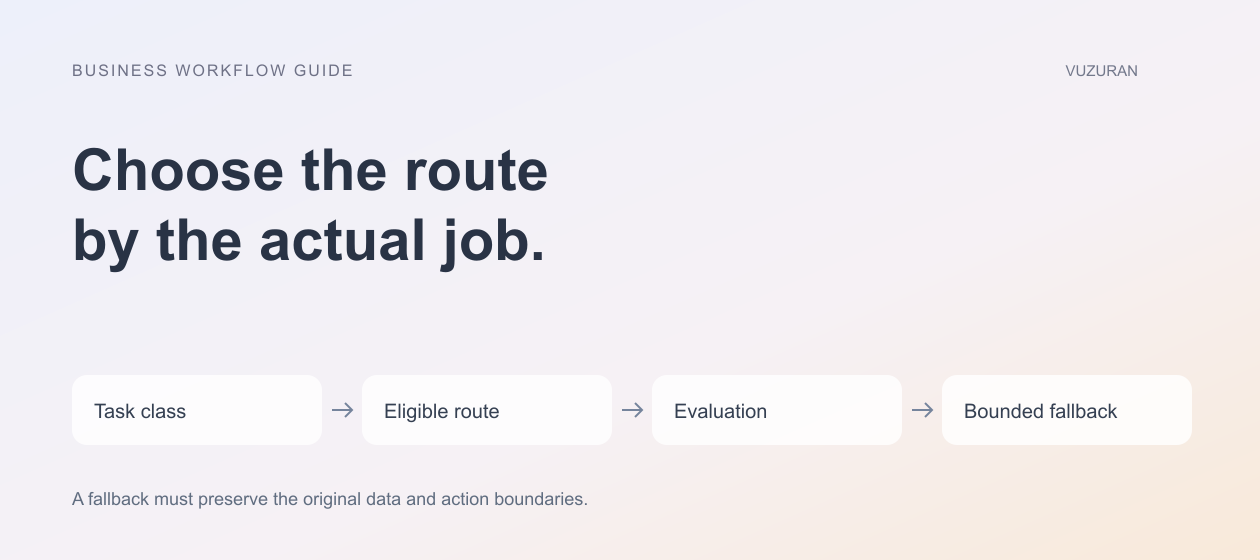
A fallback route must satisfy the same data and action boundaries as the route it replaces.
This matters during an outage. A system should not quietly move a private document to an unapproved provider just to avoid showing an error. A visible pause or review queue can be the correct operational result.
Build an evaluation set for each job
Choose representative examples with known acceptable outcomes. Include ambiguous input, missing evidence and requests outside the intended scope. Keep a separate final set so the team does not tune the router exclusively around its development examples.
For extraction, check the required fields and handling of missing values. For a supported answer, inspect whether the cited material actually establishes the claim. For a proposed action, verify that the route respects the authorization boundary.
Do not assume a general benchmark score answers these questions. Evaluate the model and prompt configuration inside the workflow where they will be used. Include the surrounding retrieval, tools and validation rules.
Use a routing decision table
A table makes the policy reviewable without requiring everyone to read implementation code. The example below is hypothetical and should be adapted to the business.
| Task condition | Candidate path | Required check |
|---|---|---|
| Known structured input with explicit rules | Deterministic transformation | Schema and business-rule validation |
| Internal summary with complete context | Tested summarization route | Missing facts and unsupported claims |
| Question requiring approved documents | Retrieval-backed route | Access and citation support |
| Proposed external action | Preparation plus approval path | Exact target, content and authority |
| Unclear or unsupported request | Clarification or human review | No invented completion |
Assign an owner to the policy. If the router uses a model to classify the input, that classifier needs its own evaluation. Misrouting a task can matter even when the downstream model behaves correctly for the wrong category.
Compare total effort per accepted result
Measure model usage, response time, retries and review work. A cheaper first response may require more correction or additional attempts. A more expensive route may be justified for a particular task, but that conclusion needs evidence from the actual workload.
Record the acceptance definition and sample when comparing results. Keep failures visible rather than calculating cost only from the successful runs. Include the cost of the router itself if it makes an additional model call for every request.
For a small pilot, a spreadsheet with route, outcome, review time and reason for failure can be enough. Our AI automation ROI guide explains how to distinguish staff capacity from cash savings.
Design escalation without endless retries
Specify when a route should ask for clarification, try another eligible path or stop. A repeated call with the same missing evidence may simply generate a different unsupported answer.
Set a bounded retry policy and preserve the reason for escalation. A human reviewer should see what was attempted and what remains unresolved. Avoid presenting several conflicting outputs as though their number proves reliability.
When an action has an uncertain external result, resolve that uncertainty before changing models or repeating the action. The issue may be a completed CRM write with a lost response, not an inadequate language model. Our API integration guide covers that recovery case.
Editorial principle: route uncertainty to the right kind of check before spending more on another answer.
Re-test when the system changes
A provider update, prompt edit, new source collection or tool change can alter the route's behavior. Keep the evaluation set and configuration version with the release record. Compare the revised system against the previous accepted behavior.
Monitor the distribution of task classes after launch. A change in customer requests can make an earlier cost estimate or route mix obsolete. Review new failure categories rather than assuming the original pilot remains representative forever.
VUZURAN develops custom AI tools and business workflows. A project discussion can start with your task classes, eligible data paths and acceptance tests. A single well-tested route may be simpler to operate when the workload does not justify routing complexity.
Frequently asked questions
Is model routing only about saving money?
No. It can separate task requirements, permissions and review paths. Cost is one measure alongside correctness, response time and operating effort.
Should the shortest request use the cheapest model?
Length alone is a weak rule. A short request can involve an important decision or action. Classify the job and consequence before choosing a route.
Can the router use another AI model?
Yes, but its classification must be tested. An incorrect route can undermine an otherwise capable downstream model.
What should happen when no eligible model is available?
Use the defined fallback, such as a pause, clarification or human review. Do not bypass the data boundary simply to return an answer.
Sources & context
- Anthropic: Building effective agents
Primary documentation reviewed October 27, 2026. Original editorial frameworks and explicitly hypothetical examples; not provider-endorsed or measured customer results.
Written by VUZURAN. Examples labeled hypothetical are illustrative; they are not customer results. VUZURAN service references describe our own business.