

An inquiry receives a score of 82. The sales team moves it to the top of the queue, but nobody can explain which facts produced the number. The message may show a real need, or the model may have inferred budget and urgency from confident language.
AI lead qualification is more useful when it helps a team understand an inquiry and choose an appropriate next step. A score can summarize a rule, but it should not replace the supporting evidence or conceal missing information.
This guide concerns ordinary B2B sales prioritization. It is an original framework, not a tool for decisions about employment, credit, housing or other consequential eligibility matters.
Define what qualifies for the next step
Start with the action the team wants to prioritize: a discovery call, a technical review or a request for more information. “Good lead” is too broad unless everyone means the same thing by it.
List the relevant criteria and why they matter. For a software inquiry, these might include a stated workflow problem, compatibility with the offered service and enough detail to identify the next conversation. Keep unsupported assumptions out of the confirmed record.
Distinguish fit from activity. A person can read several articles without having a project that matches your service. Another can submit one precise request that deserves attention despite little recorded browsing history.
Use a rubric with an unknown state
Write criteria that a reviewer can check against the original message or an approved source. Allow “unknown” when the evidence is absent. Missing information should lead to clarification where appropriate, not a fabricated value.
| Criterion | Supported evidence | Appropriate uncertainty |
|---|---|---|
| Stated problem | The inquiry describes a specific bottleneck | General interest without a defined task |
| Service fit | The requested work matches the offered scope | Need is unclear or outside current capability |
| Timing | The person states a relevant date or stage | No timeline has been supplied |
| Systems involved | Named tools or a described environment | Integration requirements still unknown |
| Next step | A clear question or requested conversation | More context is needed before routing |
This is a hypothetical rubric, not a universal scoring model. Avoid irrelevant personal characteristics and unsupported demographic inferences. Use only information appropriate to the sales process and approved data handling.
An unknown budget or timeline should remain unknown until there is evidence.
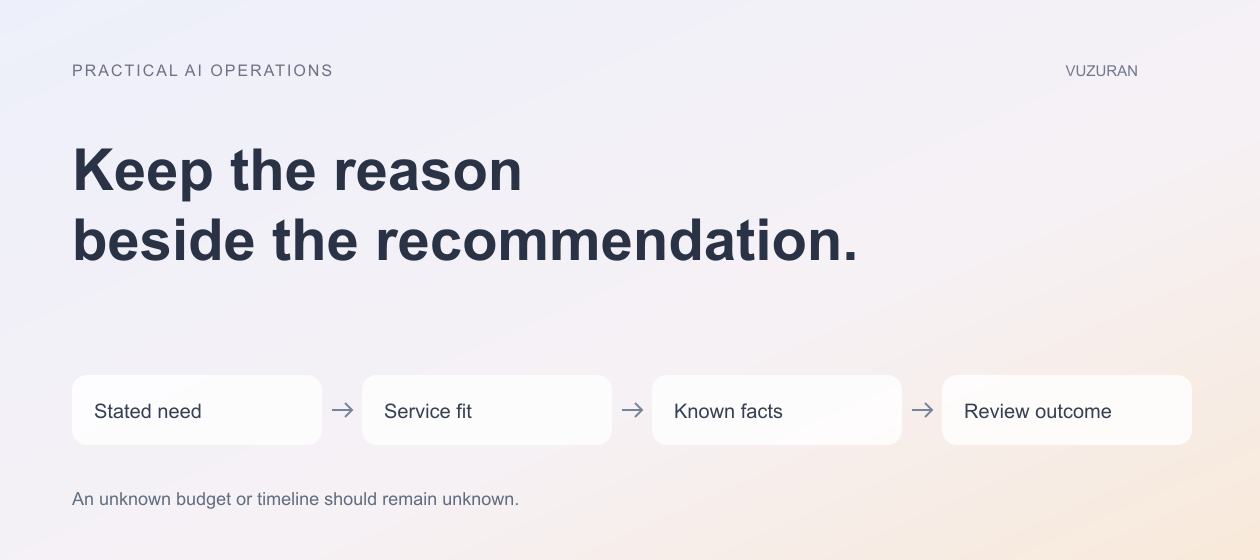
Keep the reason beside the recommendation
Show the original inquiry, the proposed category and a short explanation tied to the evidence. A salesperson should be able to correct the interpretation without opening a separate analytics project.
For example, “requests an integration assessment for an existing CRM” is a reviewable observation. “Likely to buy immediately” is a prediction that needs a defined basis and evaluation. Do not present the latter as a fact because it sounds helpful.
Preserve which fields were supplied by the person, verified elsewhere or inferred by the model. That separation makes later corrections more reliable and prevents uncertain data from spreading through the CRM.
Understand the scoring tool's scope
HubSpot's lead-scoring overview, reviewed October 27, 2026, distinguishes fit, engagement and combined scores and describes subscription-dependent capabilities. Those product options are examples of implementation choices, not proof that a particular score predicts your sales outcomes.
If you use another platform, inspect its actual rules, data and permissions. Ask whether the team can understand the score, identify the inputs and revise the criteria. A label such as “AI-powered” does not explain the decision.
Begin with a transparent baseline before adding complexity. A simple rule-based queue may be sufficient when the next step depends on a few explicit facts.
Separate prioritization from communication
A recommendation to review an inquiry should not automatically authorize a message or promise. The outreach process still needs the correct recipient, current conversation state and approved content.
If the person has replied, booked a call or changed contact preferences, update the workflow accordingly. Our lead follow-up guide explains why a scheduled message should be checked against the latest context.
Keep unsupported or ambiguous requests visible to a human rather than automatically discarding them. A small business may receive a valuable inquiry written briefly or in unfamiliar language.
Evaluate both selected and rejected inquiries
Review a sample across categories. If the team inspects only high-scoring leads, it cannot see useful requests that the system placed at the bottom or excluded.
Record why a reviewer changes the recommendation. Group corrections into missing evidence, misunderstood request, outdated service information and unsuitable criteria. These causes need different fixes.
Measure the usefulness of the next action, not only whether the score matches a teammate's first impression. A discovery call may reveal that an inquiry was misunderstood. Preserve that feedback without rewriting the original evidence as though the later information was known earlier.
Avoid self-reinforcing reporting
A queue changes which inquiries receive attention. If only the highest-scoring group gets a fast response, later outcomes can reflect that treatment as well as the original fit. Do not assume the resulting conversion difference proves the model was correct.
Keep the evaluation method explicit and review whether important categories are being overlooked. Report sample size, period and limitations when discussing results. Do not promise that qualification automation guarantees clients or revenue.
Our agent evaluation guide offers a structure for representative cases and release decisions. Use the actual workflow, not an invented accuracy percentage.
Keep the model aligned with the current business
Services, availability and target customers can change. Assign an owner to update the criteria and approved reference material. Re-test the queue when those changes affect routing.
VUZURAN builds AI agents and connected B2B tools. A project discussion can begin with your inquiry examples, fit criteria and review process. A useful first release should make the reason for a next step clearer, without turning uncertain assumptions into sales facts.
Frequently asked questions
Is a high score proof that someone will become a client?
No. A score reflects the configured method and available information. It cannot guarantee intent, fit or a sale.
Should missing information lower the score automatically?
Use an explicit policy and preserve uncertainty. A clarification may be more appropriate than treating an absent field as a negative fact.
Can AI reject inquiries without review?
Define the boundary carefully. Review ambiguous and excluded categories so the system does not silently hide useful requests.
What should a salesperson see?
Show the original inquiry, evidence, proposed next step and uncertainty. A number without an explanation is a weak basis for action.
Sources & context
- HubSpot: Lead scoring overview
Primary reference reviewed October 27, 2026. Original editorial framework and hypothetical business examples; no certification, legal-compliance or outcome guarantee.
Written by VUZURAN. Examples labeled hypothetical are illustrative; they are not customer results. VUZURAN service references describe our own business.