

“Where is my order?” sounds like a simple question. The answer can depend on the correct customer account, a split shipment, an updated carrier event or a purchase that has not yet been fulfilled. A helpful reply needs the relevant record, not just a fluent explanation of the store's shipping policy.
AI ecommerce customer support works best when the business separates general information from account-specific facts and authorized actions. That distinction matters for physical goods, subscriptions and digital downloads alike.
It does not claim that a particular chatbot can access every store system or perform every action without configuration.
Establish the source for each answer type
Create a small source map. Product questions should use current catalog information. Shipping questions may require fulfillment and carrier data. Refund requests need the applicable policy and an authorized decision path.
Do not let the assistant substitute one source for another. A product description cannot establish whether a particular order shipped. A general returns page cannot establish that a specific customer is eligible for a refund.
For digital products, identify what proves entitlement and which system issues an authorized download link. A support agent should not expose a private file merely because someone knows the product name.
Keep merchant tools distinct from customer-facing support
Shopify's Sidekick documentation, reviewed October 27, 2026, describes an AI commerce assistant in the Shopify admin that works with store data and presents changes for review. That is a merchant workflow. It should not be described as proof that a public support chatbot automatically has the same data access or approval controls.
When evaluating a customer-facing tool, inspect its own integrations, authentication and action permissions. A vendor screenshot of an administrative assistant does not establish what a visitor on the storefront can safely ask it to do.
List the exact operations the support integration needs. Reading an order status and changing its delivery address are different capabilities. Enable only the ones the approved workflow requires.
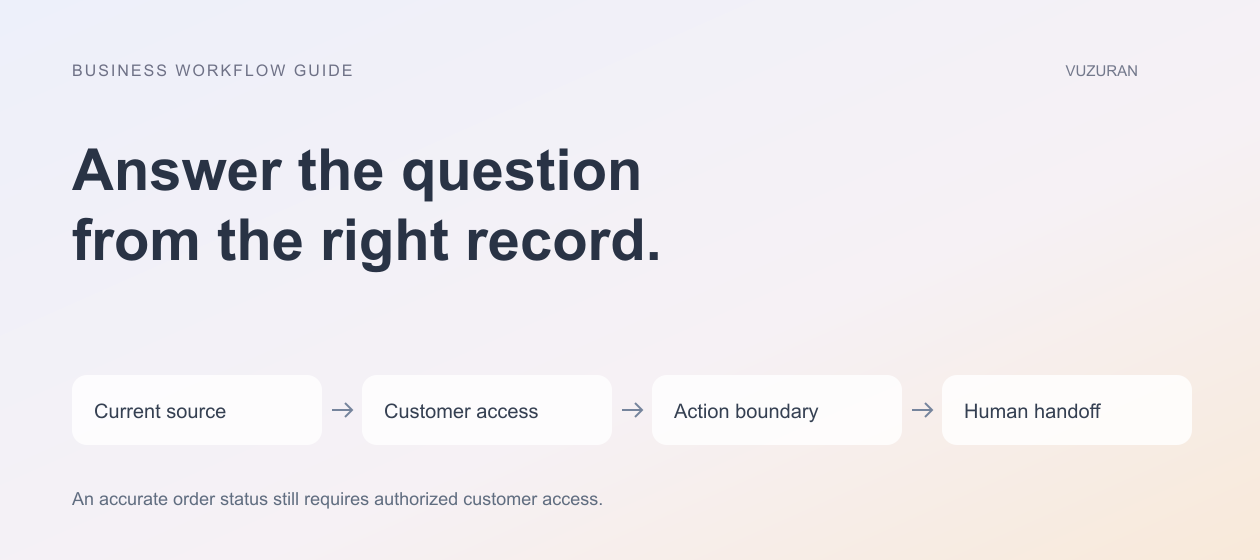
Verify the customer before revealing private details
Define how the application establishes access to an order. An order number or email address typed into a chat may be useful context, but it should not be treated as universal proof of ownership.
Keep the verification mechanism in the application and approved support process. The language model should not invent a new identity check because a customer sounds convincing. Avoid exposing internal notes, another customer's details or payment information in a helpful-looking answer.
A correct order status is still an inappropriate answer if it is shown to someone who is not authorized to see the order.
Test with two accounts and similar names. Check that the integration cannot retrieve another customer's order by changing a record identifier or rephrasing the request.
Show freshness and uncertainty honestly
Order and inventory information changes. Record when the relevant data was retrieved and distinguish a store event from a carrier event. If the connection is unavailable, explain the limitation and offer the defined next step.
Avoid turning an old estimate into a guaranteed delivery date. If the system provides a range or a pending status, preserve that qualification. A confident sentence should not be allowed to overwrite uncertainty in the source.
| Customer request | Required source | Important boundary |
|---|---|---|
| Product compatibility | Current approved product information | Do not invent unsupported specifications |
| Order status | Authorized order and fulfillment records | Verify customer access |
| Delivery update | Current available shipping evidence | Preserve estimates and unknowns |
| Download access | Purchase entitlement and delivery system | Do not share another customer's file link |
| Refund request | Applicable policy and decision process | Separate explanation from payment action |
Keep the map current when the store changes its catalog, fulfillment provider or policies. A chatbot connected once is not automatically connected correctly forever.
Handle requests that need a person
Customers may dispute a charge, report a damaged item or ask for an exception. Decide which cases can be answered from approved information and which must be reviewed. Provide a clear route to a person without forcing repeated automated explanations.
Include the order reference, verified context, attempted steps and escalation reason in the handoff. Preserve what the customer already told the agent, while avoiding unnecessary copies of sensitive information.
Our support-agent pilot guide explains how to test the handoff itself. Creating a ticket is only the beginning; someone must own it and know how to respond.
Prevent duplicate actions during recovery
A refund, replacement request or resend operation should have a clear authorization rule and a record of what happened. If a request times out, reconcile the result before repeating it.
Do not mark an order refunded because the agent wrote “I have refunded you.” The payment or commerce system must provide the relevant confirmation. Show pending and failed actions accurately in the operator's queue.
For digital delivery, distinguish issuing a new authorized link from creating a second purchase or changing entitlement. The customer needs access to what they bought, not a confusing set of duplicate records.
Test the support experience after changes
Build a permitted test set covering ordinary orders, partial fulfillment, missing information, expired links and unsupported requests. Include policy updates and products that have changed since the first configuration.
Measure useful resolution, repeated contacts, human review effort and incorrect account-specific answers. Keep security failures visible separately from writing quality. A reassuring tone does not compensate for revealing the wrong record.
Review completed cases as well as escalations. A conversation can be closed while the customer still lacks the file or information they requested. Use the underlying outcome to decide whether the workflow helped.
VUZURAN builds custom AI tools and connected commerce workflows. A project discussion can begin with your source map and support handoff. Native platform features may already cover the requirement; custom integration becomes relevant when orders, delivery and support context live in different systems.
Frequently asked questions
Can a support chatbot answer order questions from the public help center alone?
It can explain general procedures, but account-specific status requires an authorized connection to the relevant order data.
Is an admin AI assistant the same as a storefront support agent?
No. Their users, permissions and actions can differ substantially. Evaluate the actual customer-facing integration rather than assuming it inherits admin features.
Should the agent automatically approve refunds?
Only within an explicitly authorized, tested process. Explaining a refund policy and moving money are separate actions with different requirements.
How often should the knowledge sources be reviewed?
Review them when products, policies or integrations change and on an agreed operating schedule. Test that the agent uses the updated source rather than an obsolete copy.
Sources & context
- Shopify: Sidekick
Primary documentation reviewed October 27, 2026. Original editorial frameworks and explicitly hypothetical examples; not provider-endorsed or measured customer results.
Written by VUZURAN. Examples labeled hypothetical are illustrative; they are not customer results. VUZURAN service references describe our own business.