
A search for an AI development company produces similar promises: expert teams, rapid delivery and business transformation. Those phrases do little to establish whether a provider can understand your workflow, build the required integration and support the result after launch.
For a US business, the practical questions concern fit, evidence and accountability. Geography can affect coordination and requirements, but a location label is not proof of delivery quality. Ask for facts you can verify rather than infer capability from branding.
This is VUZURAN's own buyer guide. We develop AI agents, custom B2B tools and SaaS. The article is not an independent ranking, and it does not assert an unverified US office, address or certification for VUZURAN.
Describe the project before shortlisting providers
Write the problem, intended users, source systems and useful first outcome. A provider experienced in creative generation may not be the right fit for a permission-sensitive business application, even if both projects use AI.
Separate the core workflow from optional features. Identify what must be confirmed during discovery, such as access to an API or the quality of source data. This helps each provider respond to the same requirement.
Our proposal-brief guide provides an original structure for this information. A clear brief also makes it easier to recognize when a provider is answering a different problem.
Ask for relevant evidence and its limits
Request examples that resemble the required work: connected records, role-based access, a review queue or a customer-facing application. A visual portfolio can show interface craft, but it does not establish backend reliability or data isolation.
Ask what the provider actually did in an example and what can be shared with permission. Respect confidentiality; a team may be unable to reveal a client's private system. They can still explain an approach, demonstrate a controlled example or provide appropriate references.
Do not treat a hypothetical demo as a customer result. A careful provider should distinguish proposals, prototypes and production work. Unsupported revenue or accuracy claims deserve further questions, not automatic acceptance.
Examine the delivery method
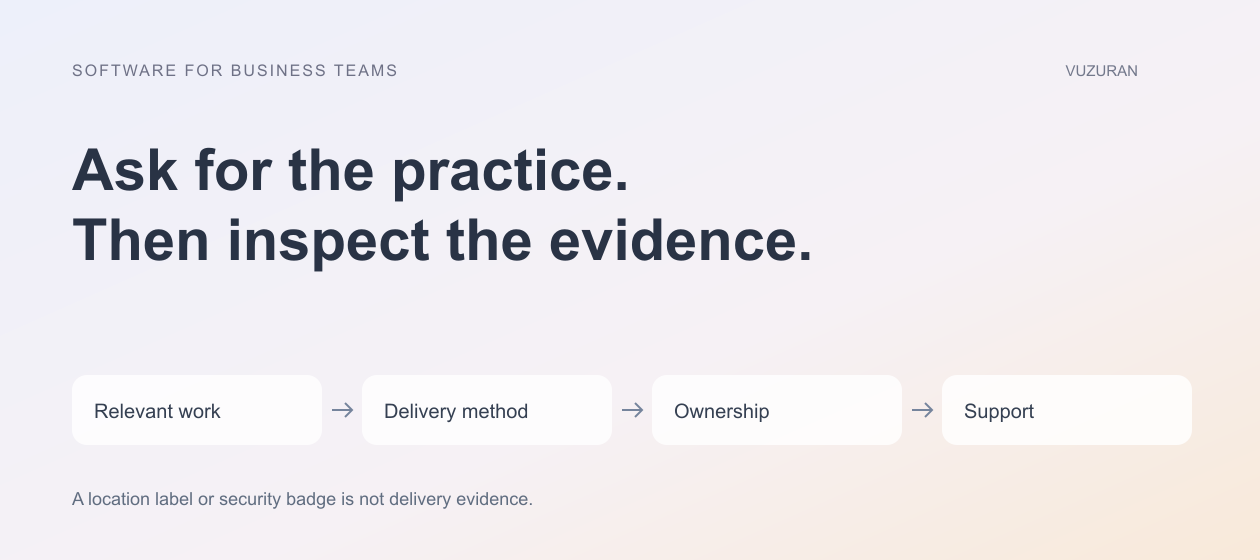
Ask how the project moves from discovery to acceptance. What will you review, how often, and what evidence determines whether a milestone is complete? A progress report should connect to working behavior.
| Area | Evidence to request | A concern to investigate |
|---|---|---|
| Scope | Deliverables, exclusions and assumptions | Broad promises without a first-release boundary |
| Integration | Test of the exact required action | Connector name used as proof of capability |
| Access | Separate-account and record-level checks | Security described only as hidden navigation |
| Quality | Acceptance cases and reported failures | A demo presented as full verification |
| Handover | Source, deployment and operating instructions | Continued operation depends on one person's memory |
| Support | Defined responsibility and response process | “Ongoing support” with no actual terms |
Use the table to guide a conversation rather than turn it into a superficial checkbox exercise. Ask to see how the practice applies to your project.
Review security practices without inventing certification
NIST's Secure Software Development Framework, reviewed October 27, 2026, provides a shared language for secure development practices and buyer-provider communication. Citing the framework is not a certification and does not prove a particular team follows it.
Ask how the provider controls code and credential access, reviews changes, tests authorization and responds to vulnerabilities. Request evidence appropriate to the engagement. Avoid demanding sensitive internal material that is unnecessary for evaluating the project.
A security claim should lead to a concrete practice and evidence, not just another badge.
For AI-specific work, include source permissions, external provider data flows and action approval. The model's behavior is only one part of the system's security boundary.
Confirm the operating relationship
Discuss working hours, timezone overlap and who makes decisions. A US team should know how urgent issues reach the provider and which person owns the project. Do not infer availability from a mailing address.
Confirm the legal entity and commercial details through the appropriate process. State any requirements for data location, vendor access or contracting explicitly, and use qualified review where needed. This article does not provide legal or procurement advice for regulated engagements.
Keep communication practical. A named channel, review cadence and decision log can prevent important scope questions from disappearing across email and chat.
Understand ownership and recurring costs
Ask who controls the source repository, cloud accounts, domain, model-provider account and deployment pipeline. Decide what will be handed over and which dependencies require ongoing licenses or subscriptions.
Separate implementation fees from hosting, provider usage and maintenance. A low initial estimate can leave substantial operating work with your team. Conversely, a managed engagement should explain what responsibility the provider accepts.
Our custom software guide explains why build, configure and integrate options should be compared on total responsibility rather than only upfront cost.
Use a small evidence-producing first stage
When the project contains uncertainty, scope a discovery or technical validation stage. Give it specific questions and deliverables: confirm the integration, test the source quality or observe a user completing the proposed workflow.
A first stage should help you decide whether to continue. It should not be a vague commitment to a large build disguised as a workshop. Record which assumptions were confirmed and which remain unresolved.
If a provider recommends an existing product instead of custom development, assess the reasoning. A smaller solution can be the correct answer when it meets the business need with less operating burden.
VUZURAN can discuss AI agents, custom tools and connected workflows with US business teams. Bring the project brief to a discovery conversation. We can explain the proposed scope, evidence and responsibilities without presenting an unverified location or a guaranteed business outcome as a reason to choose us.
Frequently asked questions
Does a US address prove the provider is a good fit?
No. Verify relevant capability, delivery method and operating arrangements. Location may matter to your requirements, but it is one fact among several.
Should we ask for an accuracy guarantee?
Ask for task-specific acceptance criteria, representative tests and a process for failures. A broad percentage without a dataset and method is weak evidence.
Can a provider show work without exposing client data?
Often they can use permitted references, controlled demonstrations or an explanation of the approach. Respect confidentiality and distinguish each kind of evidence.
What should we verify before signing?
Confirm the actual scope, assumptions, entity, costs, ownership, acceptance process and support responsibilities through the appropriate review for your engagement.
Sources & context
- NIST: Secure Software Development Framework
Primary reference reviewed October 27, 2026. Scope, examples and evaluation criteria are original VUZURAN editorial guidance; no certification or universal compatibility claim.
Written by VUZURAN. Examples labeled hypothetical are illustrative; they are not customer results. VUZURAN service references describe our own business.