

A coding assistant produces a change in minutes. The founder sees a finished screen; the engineer sees an unreviewed diff, uncertain test coverage, and a dependency nobody has evaluated. Both are looking at the same work from different points in the delivery process.
A useful rollout measures what reaches an acceptable release. Generated code is an intermediate artifact. The business still needs someone to understand the change, verify behavior, and maintain the result.
This guide uses current GitHub Copilot documentation as a concrete reference and provides an original pilot method for a small team. It is not a speed benchmark or a ranking of coding products.

Choose the kind of assistance you need
Code suggestions, repository questions, pull-request review, and delegated implementation have different permissions and review needs. GitHub's current Copilot overview describes several such experiences, including cloud-agent work and code-review feedback.
Confirm which experience your team is evaluating. A tool that answers repository questions is not equivalent to an agent that edits files and runs commands. A review assistant is another surface again. Availability and configuration should be checked for the actual account and environment.
Write the intended use beside the business need. If engineers mostly need help understanding an unfamiliar codebase, a pilot focused on autonomous feature implementation will measure the wrong thing.
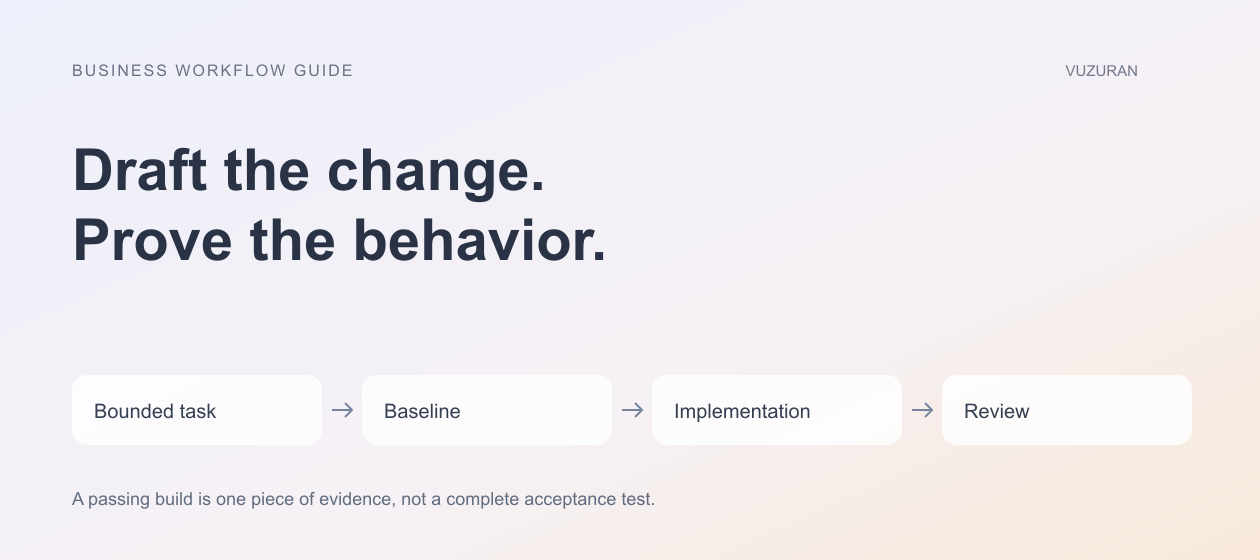
Start with a bounded change
Choose work whose expected result can be described and inspected. A specific accessibility fix, a well-scoped bug reproduction, or a missing integration test can be easier to review than a broad instruction to redesign an application.
For a hypothetical client portal, the task might be to preserve a project filter when a user returns from a detail page. The acceptance criteria should state the expected navigation behavior, affected routes, and data that must remain isolated between users.
Keep a baseline. Record which tests pass before the change and which failures already exist. Otherwise the team may incorrectly attribute an old problem to the assistant or accept a new problem because the test output was already noisy.
Provide repository context that stays useful
An assistant benefits from knowing how the project is built, which checks matter, and which files should remain untouched. GitHub documents repository custom instructions for that kind of context.
Keep instructions specific and maintainable. Name the commands the team actually uses and explain important boundaries. A long document of generic advice is less useful than a short statement of the project's real invariants.
Examples of useful invariants include tenant isolation, server-side authorization, stable public URLs, and retaining a particular customer workflow. Instructions should help the assistant understand why those boundaries matter. They do not replace enforcement or review.
Review behavior before presentation
A polished interface can hide a broken state transition. Inspect the code path that reads data, checks permissions, changes records, and reports success. Compare that behavior with the task's acceptance criteria.
A passing build does not prove that the feature works for the right user with the right data. Run checks that match the change. For a portal fix, that may include returning to the list, refreshing the detail route, using the keyboard, and attempting to access another user's record.
Do not accept a rewritten test merely because it turns the output green. Decide whether the requirement changed. If it did, document the new expectation and retain the test's original protection wherever possible. If it did not, investigate the implementation.
Make the review cost visible
Track time spent specifying the task, reviewing the diff, correcting mistakes, and verifying the result. A fast initial draft can still be useful, but it should not be reported as the full delivery time.
Keep notes on which tasks the assistant handles well and which require substantial supervision. A team may find that repository exploration saves more effort than generated implementation, or that repetitive migration work benefits more than ambiguous product decisions.
Use a practical acceptance sheet:
| Review question | Evidence the reviewer should see |
|---|---|
| Did the requested behavior change? | A reproduction or scenario showing before and after |
| Were unrelated flows preserved? | Relevant regressions and a scoped diff |
| Is access enforced correctly? | Server-side checks and role-specific tests |
| Can the team maintain the change? | Clear code, appropriate dependencies and operating notes |
| What remains uncertain? | Explicit limits rather than a broad “fully tested” claim |
The worksheet is original guidance. It does not imply that one set of tests proves an entire application correct.
Treat AI review as another input
GitHub's responsible-use application card discusses its agentic experiences, their limitations, and the role of oversight. A review assistant can help identify issues, but its comments are proposals to evaluate.
Require a reproducible explanation for a significant finding. Ask which input triggers the problem, which code path is affected, and what evidence would show that the fix works. This helps avoid spending time on confident but irrelevant comments.
The same standard applies to a claim that code is safe. An absence of review comments is not proof that no defect exists. Keep human accountability for decisions about the release.
Limit access to the task
Review the execution environment and the resources the assistant can reach. Avoid supplying production secrets or customer data merely to make a demonstration convenient. Use test data and a suitably scoped development environment.
Separate code preparation from deployment authority. A tool can help create a reviewable change while the team retains control over production release. Decide how dependencies, generated assets, and external integrations are approved.
An original rollout rule is:
Give the assistant a clear task and require evidence for the result you intend to ship.
Decide whether the pilot should expand
Expand where the observed delivery process improves. Keep the task categories that work, adjust those that need better context, and pause those that create excessive review burden. Do not infer business-wide productivity from one unusually successful demonstration.
VUZURAN develops custom business tools and AI workflows. If your team needs help integrating AI assistance into an existing application process, a discovery conversation should focus on the engineering constraints, user workflows, and verification you need to preserve.
Frequently asked questions
Should we measure lines of code generated?
That is a weak delivery measure. Track acceptable changes, review effort, regressions, and the time needed to reach a verified result.
Can an AI reviewer replace the engineer reviewing a release?
Treat its feedback as assistance. The team still needs to evaluate findings, understand the change, and accept responsibility for the release.
What is a good first task?
Choose a bounded change with a reproducible problem and explicit acceptance criteria. Avoid using an ambiguous redesign as the only pilot example.
Can we give the assistant production access?
Do not make broad access the default. Define the specific task, environment, and permissions, and keep sensitive resources outside the pilot unless there is an appropriate, authorized reason.
Sources & context
- GitHub: Copilot on GitHub
Primary documentation reviewed October 27, 2026. Examples and analysis are original VUZURAN editorial guidance.
- GitHub: Responsible use of agents
Primary documentation reviewed October 27, 2026. Examples and analysis are original VUZURAN editorial guidance.
- GitHub: Repository instructions
Primary documentation reviewed October 27, 2026. Examples and analysis are original VUZURAN editorial guidance.
Written by VUZURAN. Examples labeled hypothetical are illustrative; they are not customer results. VUZURAN service references describe our own business.