

A workflow demonstration takes thirty seconds to produce a report that once took an hour. Multiplying that difference by every report in the company produces a large savings estimate. It also leaves out the person who checks the report, the exceptions that need repair, and the cost of keeping the workflow connected.
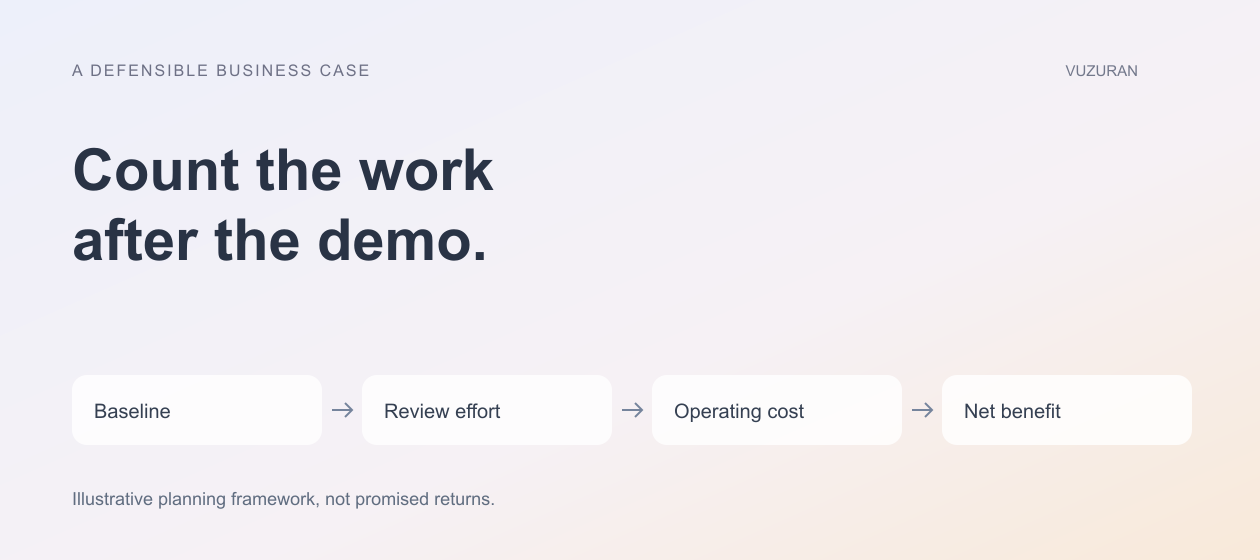
A useful AI automation ROI calculation follows the whole job. It asks how work changes after implementation, who still participates, and which costs continue after the first release. You can make that calculation before buying software, then replace estimates with observed results during a pilot.
Start with a baseline you can explain
Choose a specific workflow and a recent period. Record how many times it ran, how long people spent doing it, and what counted as an acceptable result. Use the same definition when you evaluate the automated version.
Separate active work from waiting. A task can spend three days in an approval queue while requiring only twenty minutes of staff effort. Reducing waiting may matter to customers, but it should not be counted as three days of labor savings.
Ask the people doing the work to review your baseline. If an estimate describes an unusually difficult week or excludes recurring corrections, it will distort the comparison. Preserve the assumptions so a later reviewer can reproduce the calculation.

Count the remaining work
Automation often changes where effort occurs. Staff may spend less time drafting and more time checking an output. Somebody also investigates failed runs, updates a changed field mapping, and answers questions from users.
Time saved before review is not the same as time saved after review. Include approval and correction effort in the automated process. If employees keep a parallel manual process because they do not trust the system, include that work too.
Measure a representative mix of tasks. A tool that handles routine requests quickly may still struggle with the cases that consume most of the team's attention. Report those cases separately instead of hiding them inside a reassuring average.
Use a transparent calculation
A basic monthly estimate can be written as:
Net monthly benefit = value of staff time released + separately supported business benefits − recurring operating costs.
Payback period = one-time implementation cost ÷ positive net monthly benefit.
These are planning formulas. They do not establish accounting treatment or guarantee that released time becomes cash savings. A salaried employee may use that capacity for other work while payroll stays the same. Label the benefit accurately.
The following numbers are entirely illustrative. They are not VUZURAN customer results, quotes, or market averages.
| Assumption | Before automation | During the hypothetical pilot |
|---|---|---|
| Monthly requests | 200 | 200 |
| Staff minutes per request, including checking | 12 | 7 |
| Monthly staff hours | 40 | About 23.3 |
| Capacity released | Not applicable | About 16.7 hours |
| Assumed value per staff hour | $40 | $40 |
| Estimated monthly capacity value | Not applicable | About $667 |
If recurring software, usage, maintenance, and support cost $350 per month, the modeled net benefit is about $317. A hypothetical $3,000 implementation would take about 9.5 months to recover on those assumptions. Change the assumptions and the result changes. Do not present this example as a price estimate.
Include costs that arrive later
List subscriptions, model usage, hosting, integration services, monitoring, and support. Include the time required to administer access and respond when a connected system changes. A self-hosted product can still require substantial operating work.
One-time costs may include discovery, implementation, data preparation, testing, staff training, and migration. If a workflow depends on cleaning years of inconsistent records, that effort belongs in the decision. It should not disappear because the demonstration used a tidy sample.
For a vendor proposal, ask which responsibilities are included and which remain with your team. “Maintenance included” needs a definition: response expectations, covered changes, limits, and ownership when several providers are involved.
Avoid counting the same benefit twice
Suppose faster follow-up helps a sales team respond sooner. You might measure staff capacity, response time, and conversion rate. Those are distinct observations, but they are not automatically three separate financial benefits.
Do not attribute every new sale to the automation. Demand, staffing, pricing, and campaign changes can affect results. Use a comparison that makes the uncertainty visible. If a business benefit cannot yet be supported, track it as a hypothesis rather than adding it to the payback calculation.
The NIST AI Risk Management Framework provides a broader basis for considering AI impacts and risks over time. It is not an ROI calculator. Its relevance here is the need to examine the system in its operating context rather than judging only a model's output.
Run sensitivity checks
Create a conservative case, an expected case, and a higher-adoption case. Change request volume, review time, and maintenance effort. See which assumption determines whether the project is worthwhile.
A small project may become unattractive if review takes two extra minutes per request. Another may remain useful even with modest time savings because it improves traceability or reduces missed handoffs. Explain those benefits separately and define how you will observe them.
Use this decision rule for the worksheet:
Approve the investment on assumptions the team can defend, then keep measuring the assumptions that could change the decision.
The rule is editorial guidance, not investment advice or an assurance of financial performance.
Turn the worksheet into a pilot brief
Name the workflow owner and the measurement period. State what data you will collect, who can see it, and what result would justify continuing. Include conditions for pausing or narrowing the system.
VUZURAN can help examine a workflow's implementation and operating requirements. Bringing this worksheet to a discovery call makes the conversation more useful: the team can discuss the bottleneck, integration effort, acceptance tests, and ongoing ownership before estimating a custom project.
Frequently asked questions
What is a good ROI target for AI automation?
There is no universal target. It depends on your costs, alternatives, risk tolerance, and how confidently the benefits can be measured. Set the decision threshold before the pilot.
Should we count saved time as revenue?
No. Released staff capacity and revenue are different measures. Count additional revenue only when you have a defensible basis for attributing it to the workflow.
Are free tools cost-free to operate?
They can still require hosting, staff time, maintenance, and support. Include those responsibilities when comparing alternatives.
When should we update the estimate?
Update it after the pilot and when usage, review effort, pricing, or workflow requirements materially change. Keep the earlier assumptions so the team can understand the difference.
Sources & context
- NIST: AI Risk Management Framework
Primary reference reviewed October 27, 2026. Article analysis and examples are original VUZURAN editorial guidance.
Written by VUZURAN. Examples labeled hypothetical are illustrative; they are not customer results. VUZURAN service references describe our own business.