

A customer submits a request. Your AI workflow creates a CRM task, but the connection drops before the confirmation reaches your application. The screen says the operation failed. A staff member tries again. Now there are two tasks and two people preparing replies.
The model may have interpreted the request correctly. The integration still failed the business process. Reliable AI API integration requires decisions about state, ownership, and recovery alongside prompts and tool definitions.
This guide uses a hypothetical service-business workflow. It is a planning aid for founders and implementation teams, with technical concepts explained through the actions they affect.
Identify the source of truth
Before connecting systems, decide which one owns each field. A CRM may own the customer identifier, a project tool the delivery status, and a billing service the payment state. A shared field needs a conflict rule rather than an assumption that the newest write is correct.
Write these decisions in an integration map. Include the identifier used to match records, who can change the field, and what happens when a value is missing. Avoid relying on a customer's display name as the only link between systems.
Consider a company that changes its trading name. The identity of the account should survive that change. A stable internal identifier lets the integration update a label without accidentally creating a new customer or attaching work to the wrong account.
Distinguish a timeout from a rejected action
An explicit validation error says the destination did not accept the proposed input under its rules. A timeout says you did not receive a result in time. Those states require different handling.
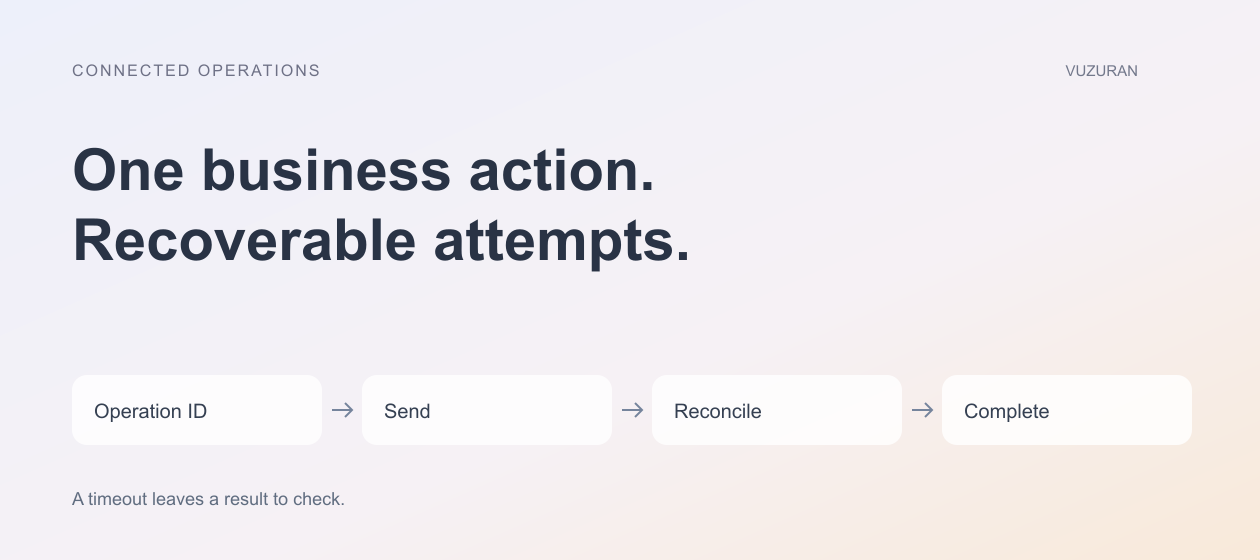
A missing response is not proof that the destination did nothing. The application needs a way to reconcile an uncertain operation before repeating it. Otherwise an ordinary network problem can become a duplicate message, booking, or record.
Show that uncertainty honestly in the interface. “Checking whether the task was created” gives the team a useful operating state. “Failed” may encourage a retry when the first attempt actually succeeded.
Use the destination's idempotency contract
Idempotency means repeated attempts at the same logical operation avoid repeating its effect under a defined contract. Support varies by API and operation, so inspect the destination documentation rather than assuming a header works everywhere.
Stripe's API reference documents idempotency keys and different behavior for its API versions. Amazon EC2 documents operations that use client tokens and parameter-mismatch handling. These are provider-specific examples, not a universal specification for every business tool.
For your workflow, create an operation identifier before sending the action and retain it across retries of that action. If the destination supports an idempotency key, follow its requirements for retention, parameters, and retry behavior. Do not put a person's email address or other sensitive data into the key.
Keep the business event separate from the attempt
An inquiry can generate one intended follow-up action and several network attempts to complete it. Store those concepts separately. The event answers what the business wanted to happen. Attempt records help explain how delivery proceeded.
A useful record might include the inquiry ID, operation ID, destination record ID, proposed action, current state, and last known response. Protect access to those records and avoid logging unnecessary customer text or credentials.
When an employee changes the intended action, create a new revision and decide whether existing approval still applies. Retrying a previously approved action is different from sending a newly edited proposal. Treating both as the same retry can bypass the review boundary.
Design a bounded retry policy
Retries need limits. Decide which errors can be retried, how long to wait, and when to hand over to a person. Follow destination rate limits and retry instructions. Repeated immediate attempts can make an overloaded service harder to recover.
Your policy should account for a service that remains unavailable beyond the normal deadline. Preserve the job and its context rather than discarding it. An operator should be able to identify affected records and recover them through a controlled process.
Do not let every layer retry independently without understanding the combined effect. A user interface, queue worker, and SDK can each repeat an operation. Document where retry responsibility lives and inspect the behavior of the libraries you use.
Test the integration at its failure points
The following test sheet is an original acceptance aid. Expected behavior should be agreed for the actual systems involved.
| Test | What the team should verify |
|---|---|
| Destination accepts the action, then the connection drops | Recovery finds the existing result without duplicating it |
| The same source event arrives twice | One intended action remains identifiable |
| A reviewer changes the proposal | New parameters do not inherit inappropriate approval |
| A record is deleted or reassigned | The integration stops or follows an explicit recovery rule |
| The destination rate-limits requests | The workflow respects the provider contract and preserves pending work |
| A different customer's identifier is supplied | Server-side authorization prevents cross-account access |
Run these tests before increasing an agent's authority. A successful demonstration on a reliable connection says little about recovery after a partial failure.
Give operators a useful recovery screen
An error log is rarely enough for the person responsible for customers. Show the affected item, intended action, last known state, and permitted next step. Distinguish “retry safe,” “needs reconciliation,” and “needs a revised request” where those states are supported by the system.
For the project brief:
A workflow is ready to operate when the team can explain and recover its unfinished work.
VUZURAN develops connected tools and AI workflows. If your current integration creates duplicate records or loses track of uncertain actions, bring a sanitized example to a discovery conversation. The project may need better state handling rather than a different model.
Frequently asked questions
Does an AI model handle API retries for us?
Your application or orchestration layer must implement the destination's contract. A model can suggest an action, but reliable execution requires software controls and observable state.
Can every API use an idempotency key?
No. Check support for the particular endpoint. When the destination lacks that feature, design reconciliation and duplicate prevention around the behavior it actually provides.
Should a user click retry after a timeout?
Only when the system can establish that doing so is appropriate. A timeout can leave the result uncertain, so reconciliation may need to happen first.
What should we log?
Log the identifiers and state needed to investigate and recover the operation. Restrict access and avoid including secrets or unnecessary personal information.
Sources & context
- Stripe: Idempotent requests
Primary reference reviewed October 27, 2026. Article analysis and examples are original VUZURAN editorial guidance.
- Amazon EC2: API idempotency
Primary reference reviewed October 27, 2026. Article analysis and examples are original VUZURAN editorial guidance.
Written by VUZURAN. Examples labeled hypothetical are illustrative; they are not customer results. VUZURAN service references describe our own business.