
A customer asks for a proposal on Tuesday. By Friday, the request has passed through an inbox, a spreadsheet, and two conversations. Nobody has replied with a clear next step. The problem is easy to describe. Deciding what software should do about it takes more care.
For a small business considering AI agents, that is a useful place to begin: one recurring job, an identifiable owner, and a result someone can check. You do not need to redesign the company around an autonomous system. You need to understand where work gets stuck and whether an agent can help without creating a second queue of corrections.
This guide lays out a supervised pilot. The examples are hypothetical, and the suggested measurements are planning tools, not promised results.
What does an AI agent add?
Some work follows a fixed sequence. A form arrives, required fields are checked, and a task is assigned. Other work requires interpretation: an inquiry may mention several services, leave out a deadline, or refer to an earlier conversation. Those differences affect the design.
Anthropic distinguishes predefined workflows from agents that choose their own next steps and tool use. Its architecture guide recommends increasing complexity only when the task needs it. For a business owner, the practical question is whether software needs to make a judgment or simply follow a rule.
Start by writing down that judgment. “Read each inquiry and suggest which team should respond” is specific enough to test. “Handle our sales” leaves too much undefined.
Choose a job with a visible finish line
Pick a process you can observe this week. Review recent examples with the person who handles them. Ask where they wait, what they look up, and what makes them stop and ask a colleague. A process diagram drawn from actual work is more useful than a list of attractive AI features.
Use a short selection table:
| Candidate workflow | A useful first outcome | Keep a person responsible for |
|---|---|---|
| New customer inquiries | A categorized request with missing information flagged | Sending a proposal or making a commitment |
| Meeting preparation | A brief linked to the relevant records | Checking facts and deciding what to discuss |
| Document intake | Extracted fields ready for review | Resolving ambiguous or conflicting documents |
| Weekly reporting | A source-linked draft with exceptions highlighted | Approving figures and interpreting their meaning |
A good pilot has enough repetition to evaluate and enough boundaries to contain mistakes. Avoid starting with a process whose source data, ownership, or approval rules are already disputed.
Define the handoff before connecting tools
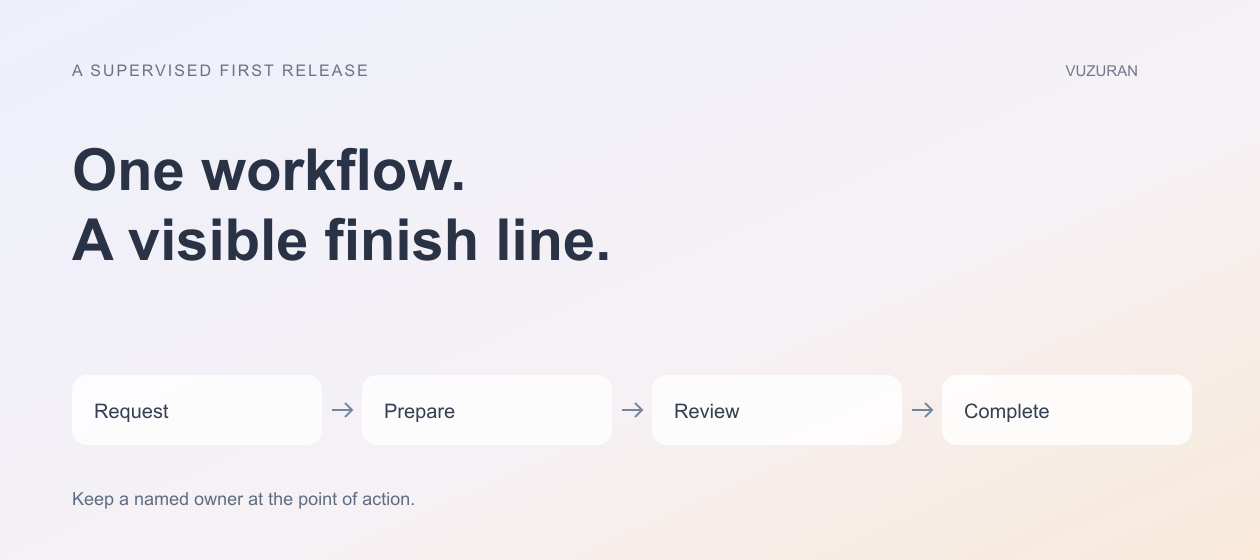
Consider a hypothetical consulting firm. An inquiry arrives through its website. A proposed system reads the submission, suggests a service category, identifies missing details, and prepares a reply. A staff member checks the draft and sends it.
The agent should see only the records needed for that job. It should not receive unrestricted access to every customer conversation because a broad connector is convenient. Specify the permitted sources, allowed actions, and conditions that require review.
An operating rule for this pilot could be:
Prepare the recommendation and show its sources. Let the assigned owner decide whether it should become an external action.
That is an original editorial recommendation, not a quotation from a customer or software provider. It also provides a useful test: can the reviewer understand why the proposed action is reasonable without repeating all the research?
Make approval a real step
A review button needs an owner and an expiry rule. Decide who receives the request, what information they see, and what happens if nobody responds. A pending request should not silently become permission after a delay.
In n8n, human review can gate selected agent tools. Approval permits the specified tool action; denial cancels it. This is one implementation option. The same operational questions apply when your team uses another platform or custom software.
For the consulting example, the reviewer needs the original inquiry, proposed category, draft reply, and destination. If any of those change after approval, the system should request a fresh decision. An approval for one message should not authorize a later, different message.
Test the awkward cases
Build a small evaluation set from representative requests, using sanitized or synthetic records where appropriate. Include clear requests, incomplete ones, duplicates, and examples that belong outside your service offering. Record what a good response should do before testing the system.
A missing email address should lead to an explicit exception. A repeated submission should not trigger two replies. A request containing instructions to ignore the workflow should remain customer input, not become an administrative command. A disconnected CRM should produce a recoverable failure rather than a success message.
Keep the test set when the pilot ends. A later prompt, model, connector, or policy change can alter behavior. Replaying the same cases gives the team a way to see what changed.

Measure the whole job
Track completion time from intake to approved outcome. Also track reviewer effort, corrections, abandoned runs, and duplicate actions. Faster draft generation is useful only when the surrounding work improves.
For a simple planning calculation, estimate the monthly value of time saved and subtract software, usage, maintenance, and review costs. Label estimates clearly. After the pilot, replace them with observed results from your own process.
Review failures alongside averages. A workflow that performs well on routine inquiries may still require changes if uncommon cases consume a disproportionate amount of staff attention. Write down who will monitor it after launch and how that person can pause it.
When custom development is worth discussing
An existing product may already handle the job. Custom development becomes relevant when the workflow depends on unusual permissions, several disconnected systems, or an interface your team cannot use effectively. Document those requirements before choosing a vendor.
VUZURAN works on AI agents, custom tools, and connected business workflows. A useful conversation starts with your process and acceptance criteria. It should establish whether a custom build is justified, what remains under human control, and how the finished system will be handed over. You can discuss a workflow with the team when you have a concrete bottleneck to examine.
Frequently asked questions
Does every small business need an AI agent?
No. A rule-based automation, a better form, or clearer ownership may solve the problem. Use an agent when interpreting information or choosing a next step adds measurable value.
Can an agent send customer messages automatically?
It can be designed to do so, but that permission should be deliberate. Begin with reviewed drafts and evaluate the errors before expanding its authority.
How much should an AI agent cost?
There is no useful universal figure. Scope the workflow, integrations, permissions, usage, and ongoing support. Compare total operating cost with the problem you are trying to solve.
What should happen when the agent is unsure?
Define a specific escalation path. The system should preserve the request and its context, tell the assigned owner what needs review, and avoid pretending the task is complete.
Sources & context
- Anthropic: Building effective agents
Primary reference reviewed October 27, 2026. Article analysis and examples are original VUZURAN editorial guidance.
- n8n: Human review for tools
Primary reference reviewed October 27, 2026. Article analysis and examples are original VUZURAN editorial guidance.
Written by VUZURAN. Examples labeled hypothetical are illustrative; they are not customer results. VUZURAN service references describe our own business.