

The model service is responding, the application has no obvious errors and the monitoring chart is green. Yet several customer inquiries are waiting for an owner because the CRM update failed after the summary was generated.
This is the gap between monitoring a component and monitoring a business process. An AI agent can complete a model call while leaving the underlying job unfinished. The dashboard needs to make that difference visible.
The examples are hypothetical. They are not screenshots, performance results or claims about VUZURAN customer deployments.
Name the business events first
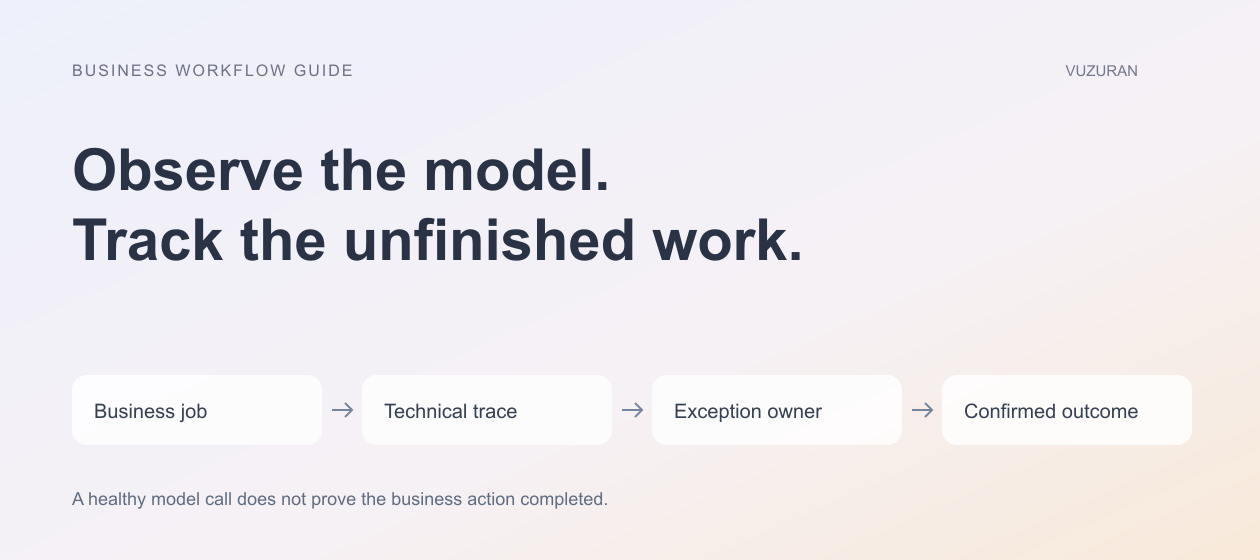
Write the stages that matter to the operator. For an inquiry workflow, these might include received, validated, prepared for review, approved, assigned and confirmed in the destination system. Include rejected, waiting and failed states where appropriate.
Give each business job a stable identifier. Use it to connect the website submission, model calls, review decision and downstream update. Without that connection, a teammate may see several technical events without knowing which customer request they belong to.
Define completion precisely. If the business requires an assigned CRM task, a generated summary is an intermediate output. Do not use one broad “success” flag for both.
A healthy model response does not prove that the business action completed.
Keep traces and outcomes related but separate
A trace helps explain how the system executed: which steps ran, their timing and where an error occurred. A business record explains what the organization still owes the user. Both are useful, and neither fully replaces the other.
The OpenTelemetry GenAI semantic-conventions repository, reviewed October 27, 2026, describes conventions for spans, metrics and events around generative AI systems. The earlier documentation location now points to this repository. Check the current convention and library versions before implementing specific fields; this article does not assume every integration exposes identical telemetry.
Use technical traces to investigate a job, while keeping the operator's view readable. A support owner should not need to interpret a raw provider response to learn that a request is waiting for review.
Build an operator view around exceptions
Start with the information someone needs to take the next action. Include the job, last verified state, age, owner and reason it is waiting. Link to detailed evidence only when needed and permitted.
| Situation | Operator question | Useful signal |
|---|---|---|
| Waiting for review | Who must decide, and by when? | Assigned reviewer and waiting age |
| Destination timeout | Did the external action happen? | Uncertain result requiring reconciliation |
| Repeated failure | Is the same problem affecting many jobs? | Failure category and related runs |
| Unsupported request | Where should this go instead? | Handoff reason and destination |
| Confirmed completion | What evidence proves the outcome? | Destination identifier and confirmation time |
Do not hide pending work inside a cumulative “processed” count. A growing queue can be the most important operational issue even while throughput increases.
Choose alerts that lead to action
An alert should identify an owner and a response. Decide which conditions need immediate attention and which belong in a scheduled review. A notification for every model call can make the important failures harder to notice.
Possible alert conditions include a sustained destination failure, an unusually old review item or a job whose result remains uncertain beyond the expected period. Set thresholds from the workflow's requirements and observed behavior rather than borrowing a number from an unrelated system.
Test the notification destination. A successfully generated alert is not useful if it reaches an unmonitored inbox. Record how a teammate acknowledges the issue and how the system avoids sending the same alert repeatedly without new information.
Record enough evidence without copying everything
Logs can contain customer messages, retrieved documents and tool inputs. Decide which fields are necessary for diagnosis and which should be removed, masked or referenced indirectly. Restrict who can access detailed traces.
Define retention separately for business records and diagnostic data. The organization may need a lasting confirmation of an approved action without retaining every intermediate prompt indefinitely.
Our internal knowledge assistant guide discusses source access and ownership. The same principle applies to monitoring: a debugging interface should not become a new place where unrelated private information is broadly visible.
Preserve the uncertain state
A remote write can time out after the destination accepts it. The application should retain “unknown pending reconciliation” when that is the actual situation. Converting uncertainty into failure can trigger an unsafe retry; converting it into success hides unfinished verification.
Show the operator what has been checked and what remains to be checked. Include the operation identifier and destination record when available. Our API integration guide explains the recovery pattern in more detail.
Editorial principle: monitoring should make uncertainty actionable instead of painting it green.
Keep a history of state changes so a later reviewer can reconstruct the sequence. If someone corrects the record manually, record that intervention and its basis rather than overwriting the evidence of the earlier failure.
Review quality beyond availability
A system can be available while producing unsupported answers or poor routing decisions. Sample completed jobs for quality and examine rejected or corrected outputs. Separate writing changes from factual corrections and authorization failures.
Compare results by task type. A single average can conceal a weak category that the business cares about. Add confirmed production failures to the evaluation set after removing unnecessary sensitive information.
Track configuration versions for prompts, models, tools and retrieval sources where relevant. When quality changes, the team needs to know what changed in the system as well as what changed in the incoming work.
Make the operating handover concrete
Before launch, ask a teammate to diagnose a controlled failure using the dashboard and runbook. Can they identify the affected job, understand the consequence and choose the permitted recovery step? If not, the monitoring is incomplete even if the charts render correctly.
VUZURAN builds custom AI tools and connected business software. A project discussion can begin with the business events, exception queue and evidence needed for your workflow. Existing monitoring may already cover the requirement if it exposes the right outcomes and ownership.
Frequently asked questions
Is token usage enough to monitor an agent?
No. Usage can explain part of operating cost, but it does not establish answer quality, authorization or completion of the business action.
Should every prompt be stored in logs?
Decide based on diagnostic need, approved data handling and retention. Store only what is appropriate, with access controls and a clear purpose.
What should an operator see first?
Show unfinished or uncertain work, its age, owner and next permitted action. Detailed traces can remain available for investigation.
How do monitoring and evaluation differ?
Monitoring observes the running system. Evaluation checks behavior against defined expectations. Production failures can inform future evaluation cases, but the two activities answer different questions.
Sources & context
- OpenTelemetry: GenAI semantic conventions
Primary documentation reviewed October 27, 2026. Original editorial frameworks and explicitly hypothetical examples; not provider-endorsed or measured customer results.
Written by VUZURAN. Examples labeled hypothetical are illustrative; they are not customer results. VUZURAN service references describe our own business.